

Myopia
Patients with stable myopia when corneal parameters permit safe surface ablation.
TransPRK is surface laser vision correction without a corneal flap. The laser removes the epithelium in the treatment area and reshapes the cornea; a therapeutic lens is usually placed during healing.
Patients with stable myopia when corneal parameters permit safe surface ablation.
Patients with myopic astigmatism when the magnitude and axis are within the current platform’s treatment range.
Patients for whom the surgeon considers corneal flap creation undesirable. People whose occupation or activity makes avoidance of a flap relevant, after individualized return-to-activity planning.
Patients with a relatively thin cornea when tomography and residual-tissue calculations confirm safety. Thin cornea alone is not an automatic indication.
Patients who need surface correction and for whom the surgeon prefers transepithelial laser epithelial removal over a separate mechanical step.
Patients with realistic expectations who can follow a longer recovery plan than is typical after flap or lenticule procedures.
TransPRK does not guarantee 20/20 vision and does not eliminate surgical risk.
TransPRK remains a surface-ablation procedure, so the absence of a flap does not mean the absence of a postoperative wound surface. While the epithelium regenerates, pain or burning, tearing, photophobia, fluctuating vision and marked eye sensitivity may occur. Later effects may include dryness, glare, halos, residual refractive error, regression and subepithelial corneal haze.
TransPRK does not treat cataract, glaucoma, keratoconus, retinal disease or other causes of reduced vision.
Increasing pain, marked redness, discharge or worsening vision requires earlier medical review.
Comprehensive refractive diagnostics are required before TransPRK. The refractive surgeon evaluates visual acuity and refraction, stability of the prescription, corneal thickness and geometry, topography or tomography, the epithelium and tear film, pupil size, crystalline lens and retina. Contact lenses can temporarily alter corneal shape, so KazRIED should specify the discontinuation period according to lens type.
Preoperative tests and day-of-procedure restrictions should be taken only from the institute’s current protocol.
Seek prompt review for increasing pain, marked redness, purulent discharge, eye trauma or noticeable worsening of vision.
TransPRK does not guarantee 20/20 vision and does not eliminate surgical risk. Seek prompt review for increasing pain, marked redness, purulent discharge, eye trauma or noticeable worsening of vision.
Book a consultation
Refraction, corneal thickness and shape, topography or tomography, ocular surface, crystalline lens and retinal assessment.
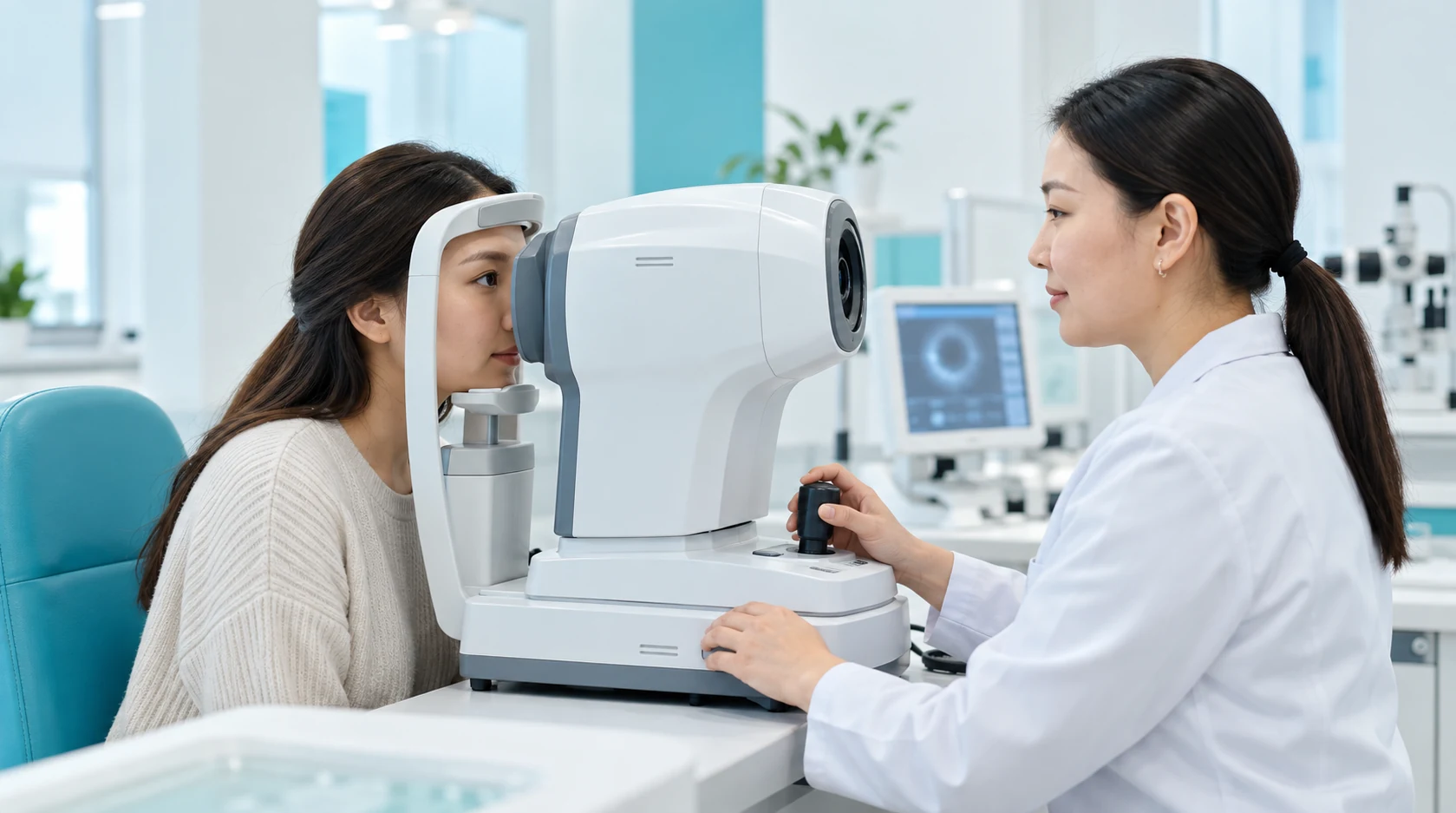
The surgeon compares TransPRK with PRK, Femto LASIK, LASIK, ReLEx SMILE and CLEAR, then confirms corneal-surface suitability.

Following lens-discontinuation timing and KazRIED instructions and confirming required tests and medicines.

Anaesthetic drops and a lid speculum are used; the clinic confirms the protocol.

The excimer laser removes epithelium in the planned zone and performs stromal refractive ablation.
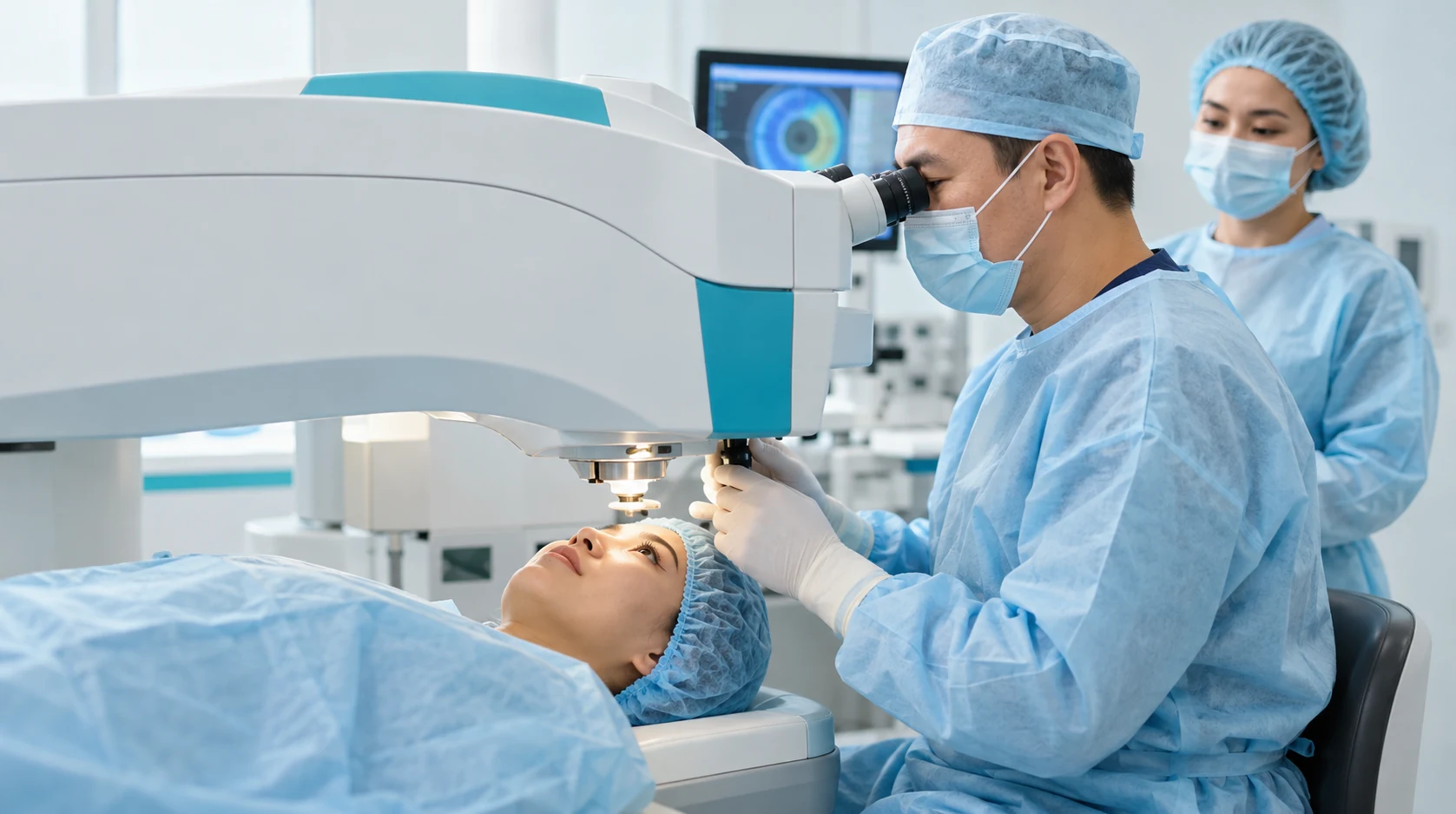
After laser treatment, the doctor treats the surface according to protocol and places a therapeutic lens if planned.

The epithelium regenerates; discomfort, photophobia and visual fluctuations may occur while prescribed medicines are used.
The doctor assesses epithelial healing, removes the therapeutic lens when indicated and monitors refraction, haze and the ocular surface.

In TransPRK, the surface epithelium is treated by laser without a separate mechanical removal stage.
The technique creates no flap, avoiding risks specifically associated with flap displacement.
Laser treatment is planned from diagnostic findings, not simply the strength of your prescription.
Laser correction can reduce the need for glasses or contact lenses when clinically appropriate.
Book pre-laser vision correction diagnostics at KazRIED. The refractive surgeon will check the cornea and refractive stability, then explain whether TransPRK is suitable or whether PRK, Femto LASIK, LASIK, ReLEx SMILE or CLEAR would be safer.
Classic PRK is a separate service; its cost is not the same as the cost of TransPRK.
A team of experienced doctors across specialties.

Candidate of Medical Sciences; Highest-category ophthalmologist

Candidate of Medical Sciences; Highest-category ophthalmologist

Highest-category ophthalmologist
TransPRK is a form of surface excimer laser refractive surgery. No corneal flap is created.
In conventional PRK, the epithelium is removed in a separate mechanical, chemical, or other step. In TransPRK, epithelial ablation is performed with an excimer laser as part of a transepithelial protocol.
The excimer laser then creates the calculated refractive profile in the superficial stroma.
After the procedure, a bandage contact lens is usually placed on the cornea while the epithelium heals.
Epithelial healing is on schedule – the bandage lens is removed when the clinician decides, prescribed therapy continues and vision is monitored.
Epithelial healing is delayed or discomfort is marked – follow-up and treatment are adjusted; the patient should not remove the lens independently.
Dryness persists after healing – the ocular surface is reassessed and lubricating treatment is adjusted.
Residual refractive error remains – stability is assessed before discussing spectacles, contact lenses or possible enhancement when indicated.
Signs of corneal haze appear – severity is assessed and the patient is managed according to the clinical protocol.
Preoperative diagnostics show that a surface method is not optimal – Femto LASIK, LASIK, ReLEx SMILE, CLEAR or another option is discussed.
Keratoconus, cataract, retinal disease or another disorder is identified – treatment of the primary condition takes priority over refractive surgery.
The key question when choosing TransPRK is whether surface correction is suitable for the individual patient’s cornea and lifestyle.
TransPRK eliminates a separate mechanical step for removing the epithelium, but healing remains characteristic of surface ablation.
Patients should therefore understand the difference between the duration of the procedure itself and the time needed for functional visual recovery.
The term “no-touch” refers to the way the corneal surface is treated with the laser, not to the absence of a healing process.
After TransPRK, the epithelium must regenerate. This process determines the course of the first few days of recovery.
Kazakhstan’s first specialized ophthalmology institute, operating since 1933.
Modern diagnostics and surgery using world-class equipment.
Leading ophthalmologists in Kazakhstan, scientists and experienced surgeons.
More than 30,000 operations and around 270,000 consultations annually.


Kazakhstan’s first specialized ophthalmology institute, operating since 1933.
Modern diagnostics and surgery using world-class equipment.
Leading ophthalmologists in Kazakhstan, scientists and experienced surgeons.
More than 30,000 operations and around 270,000 consultations annually.
Kazakhstan’s first specialized ophthalmology institute, operating since 1933.
Modern diagnostics and surgery using world-class equipment.
Leading ophthalmologists in Kazakhstan, scientists and experienced surgeons.
More than 30,000 operations and around 270,000 consultations annually.


