
Monofocal intraocular lenses (IOLs)
A monofocal IOL has one principal optical focus.
Learn moreA monofocal IOL has one principal optical focus.
Learn moreA toric IOL replaces the lens while correcting corneal astigmatism.
Learn moreA multifocal IOL provides several optical foci to reduce dependence on glasses at different distances.
Learn morePhacoemulsification removes the cloudy lens through a small incision and is followed by IOL implantation. Lens parameters are calculated before surgery according to eye health and visual needs.
Glare, halos, reduced contrast or night-vision problems are clinically attributable to cataract. Spectacle correction no longer provides the required visual quality because of lens opacity. The cataract limits examination or treatment of the retina, macula or other posterior-segment structures.
Cataract coexists with regular astigmatism and a toric IOL is being considered.
Zonular weakness or complicated cataract requires a modified surgical strategy. Cataract coexists with glaucoma or vitreoretinal disease and combined surgery is being considered.
Surgery cannot guarantee a particular visual acuity because the final result also depends on the cornea, macula, retina, optic nerve, glaucoma, diabetic changes and other ocular conditions. An IOL does not restore the natural accommodation of a young crystalline lens; spectacles or adaptation to optical phenomena may still be needed even with advanced IOL designs.
Potential complications include inflammation, elevated intraocular pressure, corneal or macular edema, posterior capsule rupture, IOL decentration/dislocation, infection, retinal detachment and others.
Cataract-related visual loss interferes with reading, work, driving, mobility or usual daily activities.
Preoperative eye assessment and IOL calculation are required. Bring previous ophthalmology reports, records of prior eye surgery and a complete medication list. Tell the surgeon about diabetes, anticoagulants or antiplatelet drugs, drug allergies, glaucoma, retinal disease, eye trauma, previous laser vision correction and any known difficulty with pupil dilation. Do not stop systemic medicines on your own.
Do not stop systemic medicines on your own.
KazRIED should provide the exact tests, consultations and preoperative medication schedule for the chosen treatment format.
Severe pain, marked redness, sudden visual loss, a curtain-like shadow, flashes or a rapid increase in floaters require urgent assessment.
Surgery cannot guarantee a particular visual acuity because the final result also depends on the cornea, macula, retina, optic nerve, glaucoma, diabetic changes and other ocular conditions.
Book a consultation
Cataract is confirmed and visual potential and risk factors assessed.
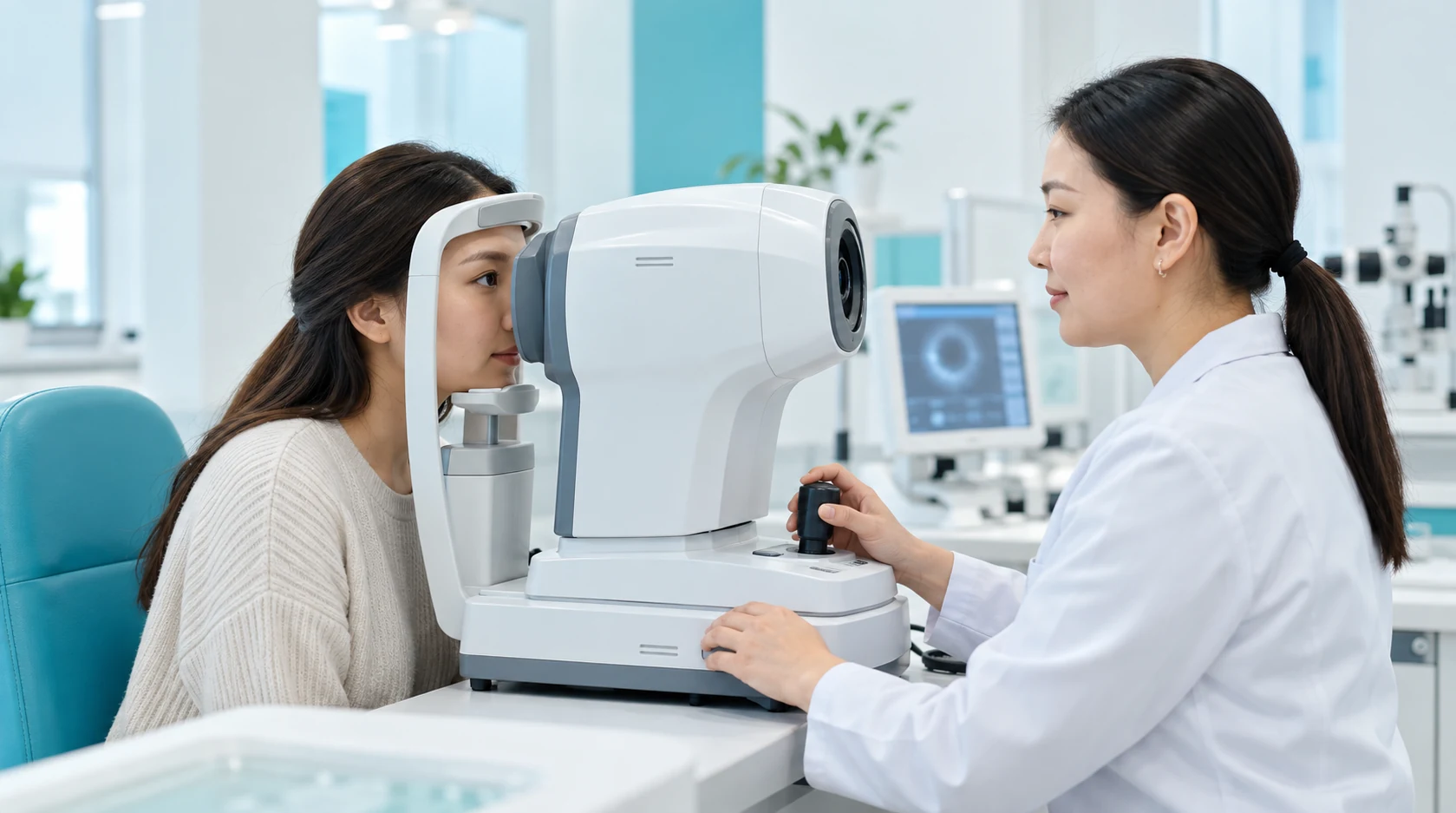
Axial length and corneal curvature are measured and the target refractive outcome discussed.

Document and eye checks, pupil dilation, antisepsis and the selected anaesthesia.

The surgeon creates an incision and performs anterior capsulorhexis.
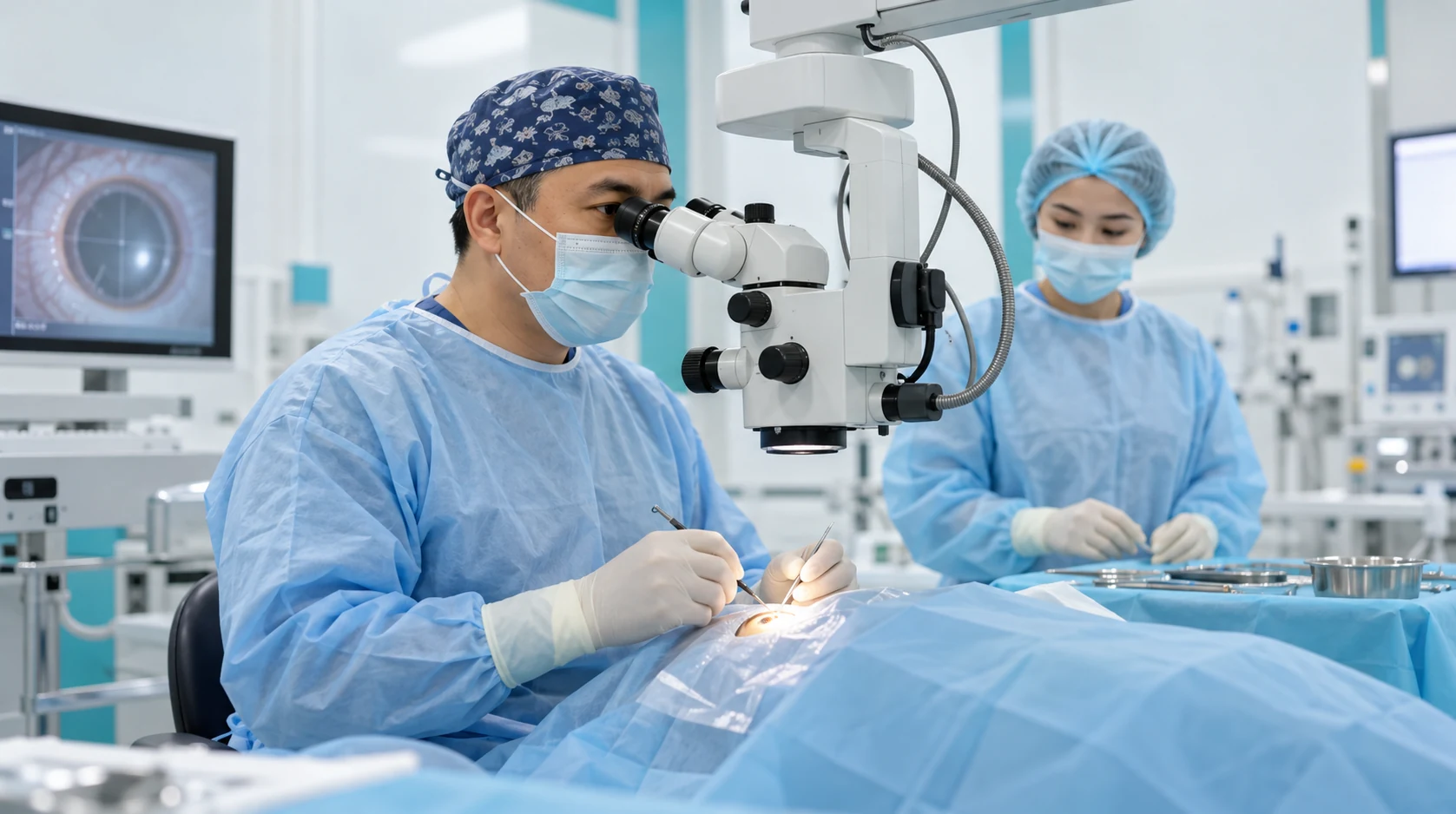
The opaque lens is fragmented by ultrasound and removed, preserving the capsular bag where possible.
A foldable lens is inserted into the capsular bag or secured differently if standard fixation is impossible.
Incision sealing and the anterior segment are assessed; sutures are used only if needed.

The patient receives a drop regimen, restrictions and review schedule; recovery depends on the method, eye health and associated conditions.

The ultrasound technique allows removal of the lens affected by cataract.
Phacoemulsification uses a small incision to remove the lens and insert an IOL.
When IOL implantation is possible, the artificial lens replaces the optical function of the removed lens.
When indicated, the surgeon can combine cataract treatment with another necessary eye operation.
The listed prices are per eye.
Book cataract assessment and an ophthalmic-surgeon consultation at KazRIED. The surgeon will determine how much the cataract affects vision, calculate the IOL and explain which phacoemulsification pathway and lens option is appropriate for your eye.
A team of experienced doctors across specialties.
Candidate of Medical Sciences, Associate Professor; Highest-category ophthalmologist

Candidate of Medical Sciences; Highest-category ophthalmologist

Candidate of Medical Sciences; Highest-category ophthalmologist

Candidate of Medical Sciences; Highest-category ophthalmologist

Candidate of Medical Sciences; Highest-category ophthalmologist

Candidate of Medical Sciences; Highest-category ophthalmologist

Doctor of Philosophy (PhD)

Highest-category ophthalmologist

Highest-category ophthalmologist

Highest-category ophthalmologist
A cataract reduces the transparency of the natural lens, allowing less light to reach the retina. Images become cloudy and less contrasted, glare appears, and vision deteriorates during everyday activities.
Phacoemulsification addresses the optical cause of cataract-related visual impairment. The surgeon makes a small corneal incision and creates an opening in the anterior lens capsule.
An ultrasound probe is then used to fragment and aspirate the clouded lens material, preserving the capsular bag whenever possible.
A foldable intraocular lens (IOL) with a precalculated optical power is implanted through the same incision.
The lens type affects focusing after cataract removal, the ability to correct astigmatism, and dependence on glasses at different distances.
In cases of zonular weakness, dense or complicated cataract, glaucoma, or vitreous or retinal disease, the surgical plan may include:
The patient therefore needs an agreed treatment plan based on diagnostic findings and the expected visual benefit.
At KazRIED, the surgical approach, IOL type, and need for additional procedures are determined after a diagnostic assessment.
Planning considers cataract density, the condition of the cornea, retina, optic nerve, and lens zonules, as well as the patient’s visual needs.
An expanded pathway is particularly relevant for complicated or dense cataract, zonular weakness or lens subluxation, significant astigmatism, glaucoma, diabetic retinopathy, epiretinal membrane, macular disease, high myopia, previous vitreoretinal surgery or prior corneal laser correction.
These situations may require additional testing, a capsular tension ring, a toric IOL, combined glaucoma/vitreoretinal surgery or an alternative lens-removal technique.
Phaco + IOL + capsular tension ring: For zonular pathology when indicated.
Phaco without IOL: For specific surgical indications only.
Tunnel extracapsular cataract extraction + IOL: Alternative method, not the same as standard phaco.
Phaco + IOL + trabeculectomy: Combined cataract-glaucoma operation.
Phaco + IOL + vitrectomy + silicone/PFCL: Complex combined vitreoretinal procedure.
Kazakhstan’s first specialized ophthalmology institute, operating since 1933.
Modern diagnostics and surgery using world-class equipment.
Leading ophthalmologists in Kazakhstan, scientists and experienced surgeons.
More than 30,000 operations and around 270,000 consultations annually.


Kazakhstan’s first specialized ophthalmology institute, operating since 1933.
Modern diagnostics and surgery using world-class equipment.
Leading ophthalmologists in Kazakhstan, scientists and experienced surgeons.
More than 30,000 operations and around 270,000 consultations annually.
Kazakhstan’s first specialized ophthalmology institute, operating since 1933.
Modern diagnostics and surgery using world-class equipment.
Leading ophthalmologists in Kazakhstan, scientists and experienced surgeons.
More than 30,000 operations and around 270,000 consultations annually.


