

Age considerations
children of any age when a clinically significant refractive error is identified; a child squints, sits close to the board or screen, holds books very near, or reports blurred distance vision;
Children’s glasses are prescribed according to refraction, visual acuity and binocular function. Trial correction guides the prescription, with advice on wear and follow-up examinations.
children of any age when a clinically significant refractive error is identified; a child squints, sits close to the board or screen, holds books very near, or reports blurred distance vision;
school-age children and adolescents with myopia and reduced distance vision; children with progressive myopia who need assessment of both vision correction and myopia management. progressive myopia requires a review of both the prescription and the myopia-management strategy.
children with astigmatism, hyperopia or anisometropia; myopia, hyperopia, astigmatism or anisometropia was found during screening or a previous examination;
patients with amblyopia or selected forms of strabismus where glasses are part of treatment; strabismus or amblyopia is present and optical correction may be part of treatment;
children who need an old prescription rechecked or damaged/poorly fitting glasses replaced; Pediatric glasses are prescribed because of a clinical need rather than age alone. current glasses no longer provide the same clarity, the frame no longer fits, the glasses are damaged, or the prescription has not been reviewed;
reading is difficult, visual fatigue or headaches occur, or the child adopts an unusual head posture;
there is a noticeable difference in vision between the eyes or one eye sees worse;
parents need to know whether glasses should be worn full time, for specific tasks, or whether another correction is more appropriate;
In children, glasses are not only a way to improve day-to-day clarity. During visual development, appropriate correction may be required for normal visual development in each eye, for reducing the risk of refractive amblyopia and for managing selected types of strabismus.
Do not select a child’s lens power from ready-made glasses, an autorefractor printout or another person’s prescription. Pediatric prescribing must account for age and clinical findings.
Not every amount of hyperopia in a young child needs glasses. Weak plus lenses without a clinical indication may be unnecessary; the decision belongs to the ophthalmologist.
Persistent refusal to wear newly prescribed glasses, double vision, substantial dizziness, pain or marked visual deterioration should prompt a recheck of the prescription and fit.
symptoms, previous prescriptions, glasses-wearing pattern, family eye history, visual change and visual demands.
Age-appropriate visual acuity assessment in each eye.
Eye injury, chemical exposure, sudden visual loss, severe eye pain, a white pupillary reflex or acute strabismus with neurologic symptoms requires urgent medical assessment rather than a routine glasses appointment.
Eye injury, chemical exposure, sudden visual loss, severe eye pain, a white pupillary reflex or acute strabismus with neurologic symptoms requires urgent medical assessment rather than a routine glasses appointment.
Book a consultation
symptoms, previous prescriptions, glasses-wearing pattern, family eye history, visual change and visual demands.

Age-appropriate visual acuity assessment in each eye.
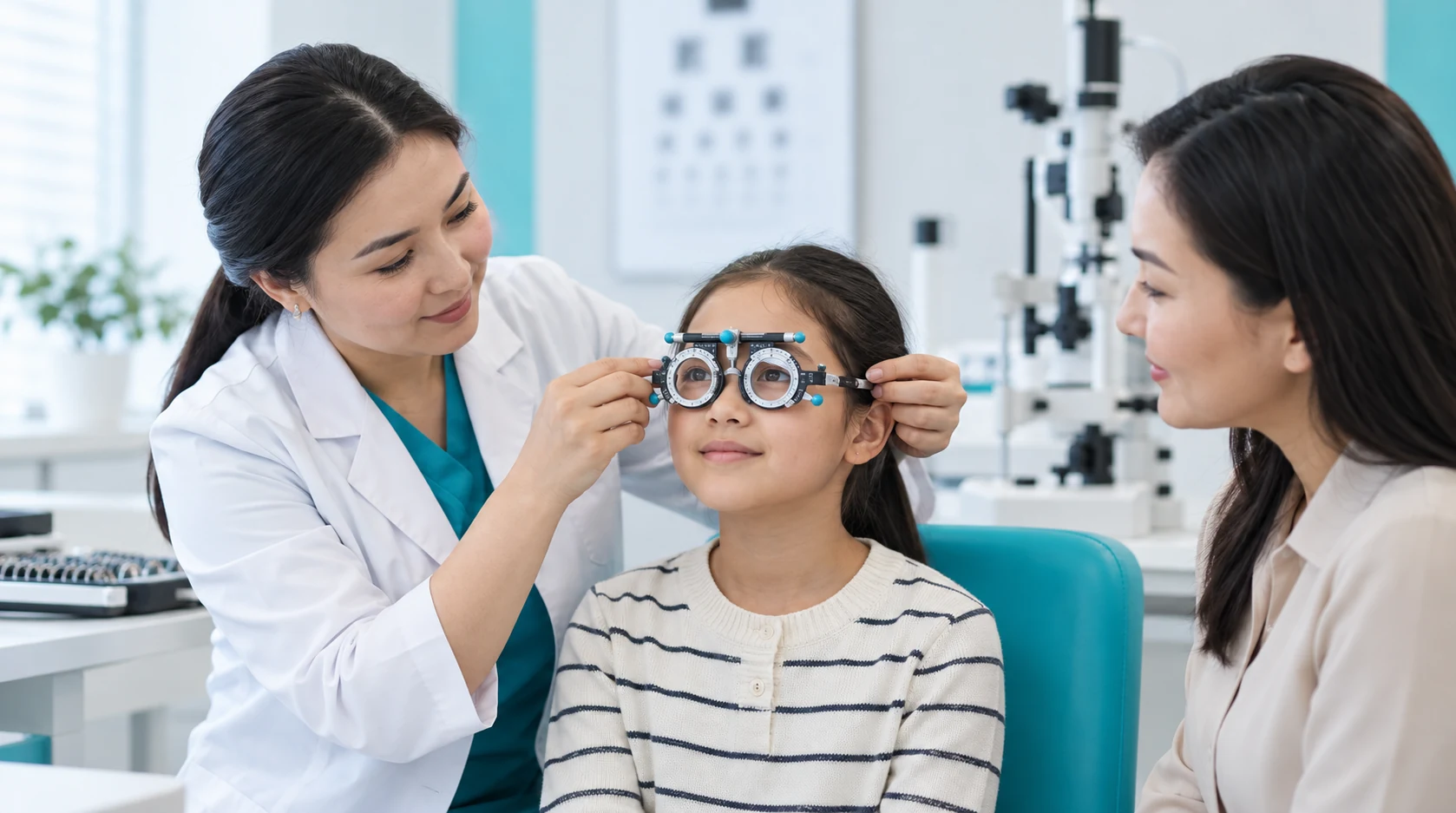
Assessment of ocular alignment, motility, binocular function and amblyopia risk when indicated.
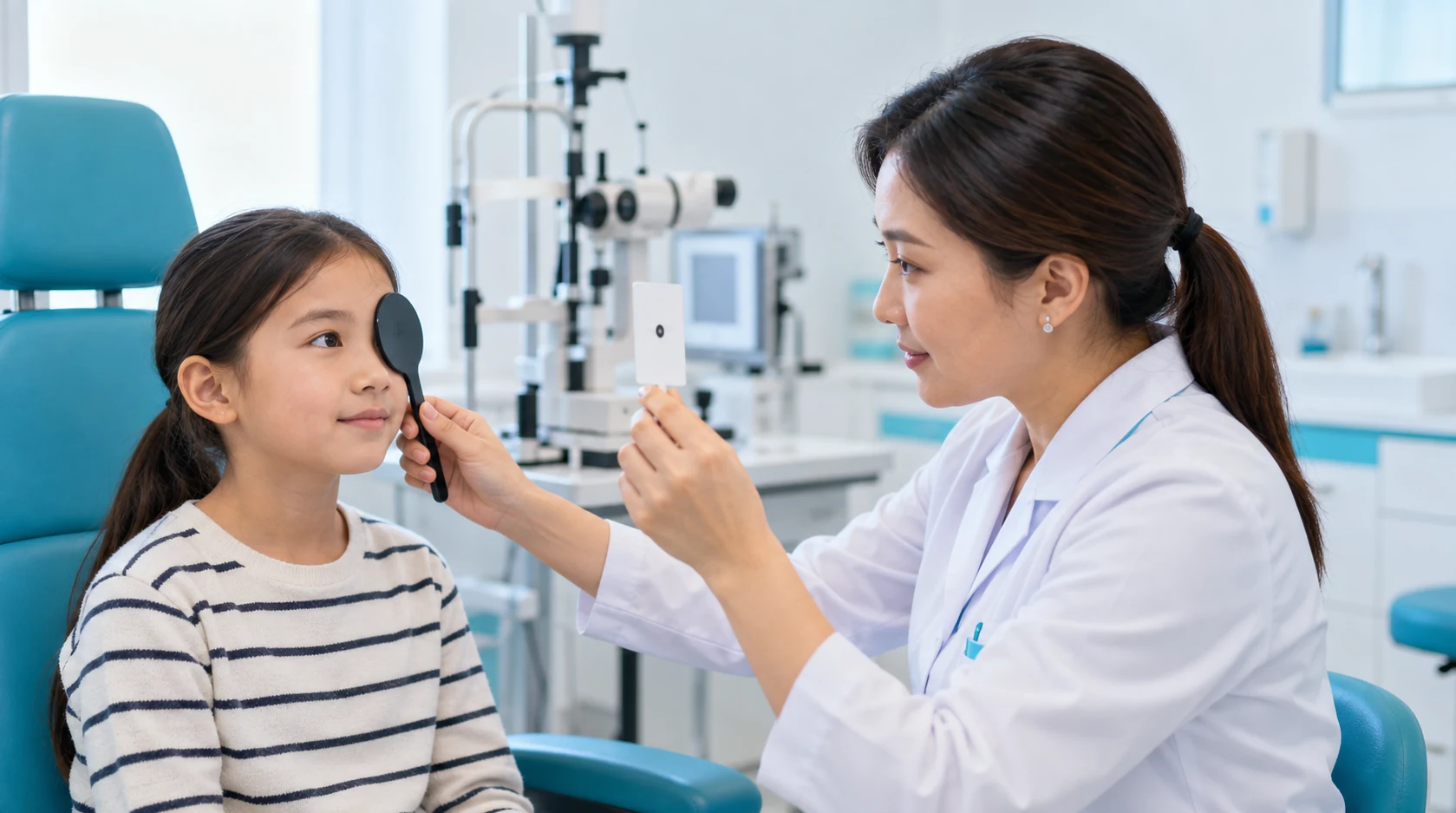
Cycloplegia may be used to temporarily relax accommodation and refine the prescription.
Trial correction is used to refine sphere, cylinder, axis and other prescription parameters.

Guidance on wearing schedule, impact-resistant lens material, frame fit and follow-up interval.

Manufacturing and dispensing of the glasses with fit and tolerance checks.
Suitable glasses compensate for refractive error and allow the child to use their available visual acuity.
Lens centration and frame position are assessed so the prescribed optics work correctly and the glasses are comfortable.
The prescription considers each eye's refraction, tolerance of correction and how the eyes work together.
Guidance for the child and parents helps ensure prescribed correction is used correctly and follow-up is maintained.
Book a pediatric ophthalmology appointment at KazRIED for spectacle prescription and selection. Bring previous prescriptions, reports and the child’s current glasses. The physician will decide whether cycloplegia is needed, determine the appropriate prescription and set the follow-up interval.
The price includes intraocular pressure (IOP) measurement and refractometry
Ophthalmologist consultation without diagnostic package
A team of experienced doctors across specialties.

Candidate of Medical Sciences; Highest-category ophthalmologist

Highest-category ophthalmologist

Highest-category ophthalmologist

Second-category ophthalmologist

Second-category ophthalmologist

Second-category ophthalmologist


For children, glasses do more than simply improve visual clarity. While the visual system is developing, properly prescribed optical correction may be necessary to support visual development in each eye, reduce the risk of refractive amblyopia and correct certain types of strabismus.
In children with myopia, the ophthalmologist evaluates distance visual acuity and changes in refraction over time. In hyperopia, the doctor determines whether the degree of farsightedness is age-appropriate and whether correction is needed based on symptoms, visual acuity and eye alignment. In astigmatism, the cylindrical component and its axis must be considered. In anisometropia, particular attention is paid to differences between the eyes and the risk of amblyopia.
The main goal of the consultation is to obtain an accurate glasses prescription and clear instructions on how the glasses should be worn. Frame selection and lens manufacturing are subsequent steps.
A child's glasses prescription should not be based solely on an autorefractor reading. Active accommodation can significantly affect measurement results, so the ophthalmologist evaluates objective refraction together with the findings of the clinical examination.
When prescribing optical correction, the doctor considers visual acuity in each eye, age, accommodation, the presence of strabismus or amblyopia, and differences in refraction between the eyes.
Cycloplegia may be performed when necessary. This involves temporarily relaxing accommodation using special eye drops. It helps obtain a more objective assessment of refraction. The ophthalmologist determines whether cycloplegia is needed, which medication to use and whether measurements should be repeated.
After the examination, the ophthalmologist determines the optical power and type of lenses, the required degree of correction, the wearing schedule and the timing of the follow-up examination.
The ophthalmologist determines not only the appropriate lens power but also whether optical correction is necessary at all. Mild hyperopia in early childhood may be physiological and does not always require glasses.
However, significant anisometropia, astigmatism or refractive amblyopia may require timely correction to support proper visual development.
Obtaining a prescription and receiving finished glasses are separate stages of vision correction. The ophthalmologist determines the medical parameters of correction, while the optical specialist ensures they are accurately implemented when manufacturing the lenses and selecting the frames.
The child's eyes must be correctly positioned relative to the lenses. Frames should not constantly slip or press against the bridge of the nose or ears. Even an accurate prescription may provide inadequate correction if the optical centers are incorrectly positioned or the finished lenses do not match the prescription.
Impact resistance is particularly important for children's lenses. The American Association for Pediatric Ophthalmology and Strabismus (AAPOS) recommends polycarbonate as a protective material for children's spectacle lenses. The final choice of lens material and frame design should take the prescription and recommendations of the ophthalmologist and optical specialist into account.
Once the glasses have been made, it is important to check that they match the prescription, fit correctly and are comfortable to wear.
As children grow, both their vision and facial anatomy change. Glasses therefore do not need to be replaced solely according to a fixed calendar schedule.
Reasons for reassessment include worsening vision, new symptoms, damaged or deformed frames, noticeable changes in fit, or reaching the follow-up date set by the ophthalmologist.
If new glasses cause persistent discomfort, their prescription accuracy and fit should be checked. If symptoms continue, the ophthalmologist determines whether another examination or a change in correction is necessary.
Standard glasses provide clear vision in children with myopia, but slowing the progression of nearsightedness is a separate clinical objective.
When myopia is progressing, the ophthalmologist assesses changes in refraction and may discuss a dedicated myopia-control program. Options may include specially designed spectacle lenses, contact lenses or pharmacological treatments. Each method requires an individual assessment of indications and ongoing monitoring.
In children with amblyopia, correctly prescribed glasses can sometimes substantially improve vision on their own. However, optical correction is not always sufficient as the only treatment.
If a difference in visual acuity between the eyes remains after a period of appropriate optical correction, the ophthalmologist evaluates the need for additional treatment. Patching or other therapies may be prescribed when indicated.
Kazakhstan’s first specialized ophthalmology institute, operating since 1933.
Modern diagnostics and surgery using world-class equipment.
Leading ophthalmologists in Kazakhstan, scientists and experienced surgeons.
More than 30,000 operations and around 270,000 consultations annually.


Kazakhstan’s first specialized ophthalmology institute, operating since 1933.
Modern diagnostics and surgery using world-class equipment.
Leading ophthalmologists in Kazakhstan, scientists and experienced surgeons.
More than 30,000 operations and around 270,000 consultations annually.
Kazakhstan’s first specialized ophthalmology institute, operating since 1933.
Modern diagnostics and surgery using world-class equipment.
Leading ophthalmologists in Kazakhstan, scientists and experienced surgeons.
More than 30,000 operations and around 270,000 consultations annually.


