

Device-based vision treatment
Device-based treatment is an individual programme of visual exercises for amblyopia and selected binocular vision problems.
Learn moreDevice-based treatment is an individual programme of visual exercises for amblyopia and selected binocular vision problems.
Learn moreStrabismus treatment aims to improve eye alignment and binocular function according to the cause. It may include optical correction, amblyopia care, functional treatment and surgery when indicated.
The deviation may be constant or intermittent and may become more obvious in photographs or when tired. Refraction, amblyopia and binocular function should be assessed.
The ophthalmologist determines how much of the deviation is accommodative and whether full spectacle correction straightens the eyes.
Frequency of deviation, control, symptoms and binocular vision help determine whether observation, non-surgical care or surgery is appropriate.
The weaker eye needs separate treatment. Eye-muscle surgery does not by itself eliminate amblyopia.
If you have double vision , note when it began, whether it disappears when one eye is closed, and in which gaze direction it is worse.
Residual or recurrent deviation requires new measurements, review of previous surgery and individualized re-operative planning.
After the cause, diplopia and binocular function are assessed, prism or surgical correction may be considered.
Sudden new strabismus or diplopia in an adult requires timely assessment of the underlying cause. Surgery changes alignment, but the result depends on the type of strabismus, baseline angle, muscle condition and neural control.
In a child, a new eye deviation, eyelid droop, unusual restriction of eye movement, a white pupillary reflex, severe headache or vomiting requires prompt medical assessment.
Patching treats amblyopia; it is not a universal way to straighten an eye. An ophthalmologist prescribes the schedule for covering the better-seeing eye.
Home exercises are useful only for selected disorders and must not replace diagnostic evaluation of the cause of strabismus.
Further treatment or another operation can sometimes be required.
KazRIED-specific age limits, anesthesia, hospitalization duration and post-operative restrictions must be confirmed for the individual patient.
Bring previous ophthalmology reports, surgical records, current spectacles, prescriptions and test results if available.
For children, vision must be assessed separately in each eye. Do not stop prescribed spectacles or patching before the visit unless instructed.
If you have had previous strabismus surgery, report its date and which muscles were operated on, and bring the medical summary if it has been preserved.
Sudden new eye misalignment, especially with diplopia, severe headache, weakness, speech problems, eyelid droop or trauma, requires urgent medical assessment rather than routine booking. Associated neurological symptoms require emergency care.
Sudden new strabismus or diplopia in an adult requires timely assessment of the underlying cause. Associated neurological symptoms require emergency care.
Book a consultation
The ophthalmologist establishes onset, constancy of the deviation, diplopia, previous surgery, trauma, and relevant neurological or endocrine conditions.

Vision is tested in each eye and optical correction is assessed.
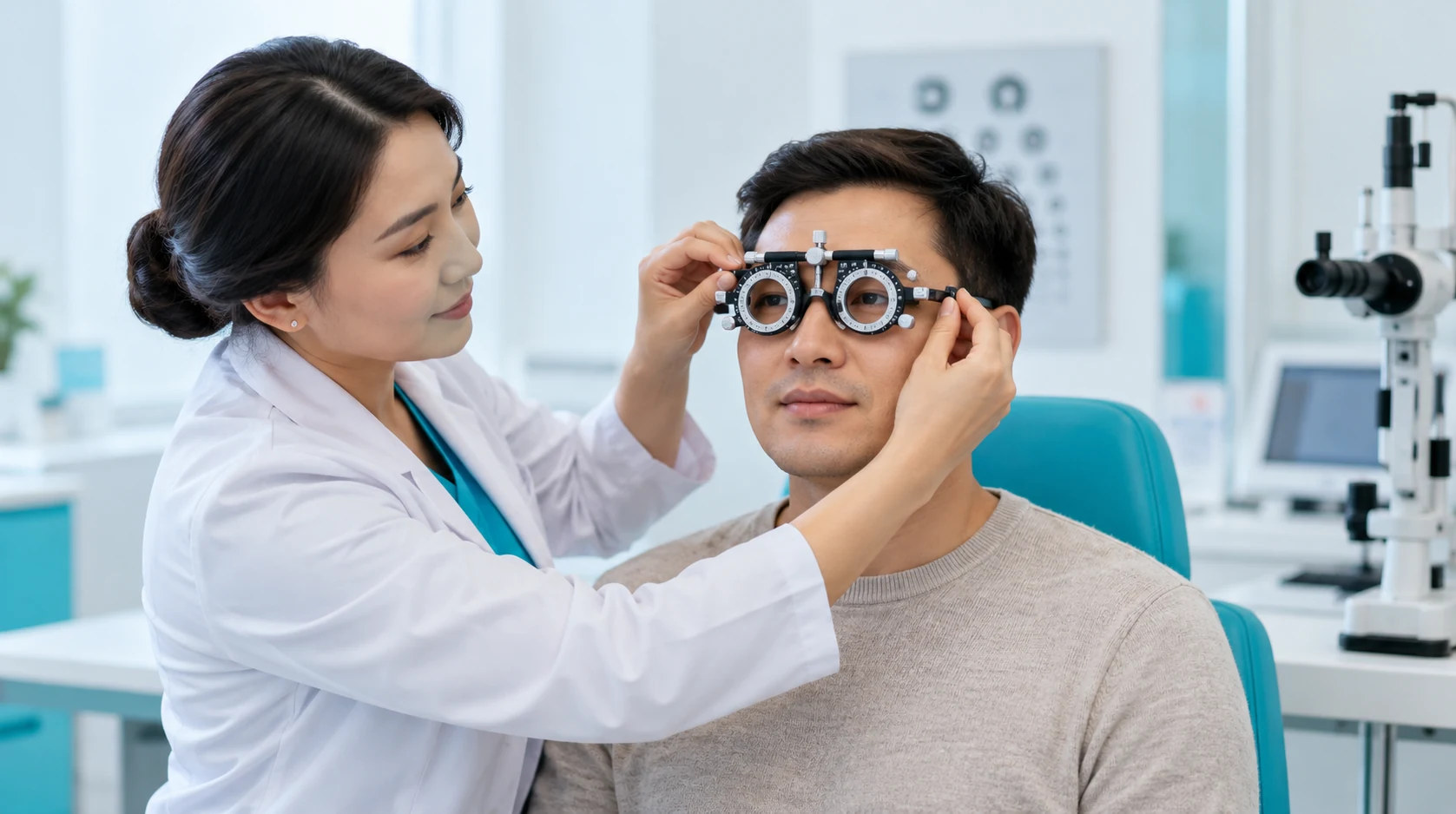
Direction and magnitude of deviation, eye movements, convergence and other ocular motor parameters are measured.

The clinician evaluates sensory status, fusional ability and amblyopia because these findings change the treatment plan.
Spectacles, amblyopia treatment, prism correction or pleoptic-orthoptic methods are prescribed according to the type of strabismus.

When adequate alignment cannot be achieved or maintained non-surgically, the ophthalmic surgeon determines indications and plans eye-muscle surgery.
Eye position, vision, diplopia and binocular function are reassessed.

Treatment aims to reduce eye deviation according to the cause and type of strabismus.
In suitable cases, correcting alignment helps reduce double vision; the outcome depends on the underlying mechanism.
The treatment plan considers the eyes' ability to work together and the need for additional functional therapy.
Glasses, prisms, exercises or surgery are considered according to indications, rather than one regimen for every type of strabismus.
Schedule a consultation with an ophthalmologist if a child or adult has an eye that turns constantly or intermittently, experiences double vision, exhibits a forced head turn, or if previous treatment did not yield the expected results.
A team of experienced doctors across specialties.

Candidate of Medical Sciences; Highest-category ophthalmologist


Second-category ophthalmologist

Second-category ophthalmologist
Strabismus means that the visual axes of the eyes are not directed at the same point. The deviation may be inward, outward, or vertical, and may be constant or intermittent.
In childhood, eye misalignment can interfere with normal binocular vision development and may coexist with amblyopia. In adults, acquired strabismus is often accompanied by double vision.
Treatment begins with identifying the cause. The clinician assesses:
In accommodative esotropia, correctly prescribed glasses can substantially reduce or eliminate the inward deviation while they are worn.
When amblyopia is present, reduced vision is treated separately with full optical correction, patching, or other methods prescribed by an ophthalmologist.
Pleoptic and orthoptic procedures target specific visual functions and should not automatically be considered a replacement for glasses or surgery.
Surgery changes the balance of the eye muscles to improve eye alignment. It does not guarantee perfect symmetry, full restoration of visual acuity, or binocular vision.
Nonsurgical treatment may be needed before and after surgery, particularly if a child has amblyopia.
In adults, strabismus treatment may have functional goals: reducing double vision, correcting an abnormal head posture, or improving coordination between the eyes.
Sudden-onset strabismus in an adult first requires investigation of the cause. It may be associated with damage to the nerves controlling eye movements, or with vascular, neurological, endocrine, or other conditions.
Depending on the examination findings, the plan may include glasses or prism correction, amblyopia treatment, pleoptic and orthoptic methods, and eye muscle surgery.
Treatment goals are individualized: to improve coordination between the eyes, reduce misalignment and double vision, and preserve or develop visual functions.
Visual acuity and refraction
Vision is tested in each eye and optical correction is assessed. Children may require age-appropriate refraction assessment.
Follow-up
Eye position, vision, diplopia and binocular function are reassessed. Further care depends on outcome and age.
Full optical correction is continued and vision and amblyopia are monitored. Surgery may not be required.
The angle, binocular function and need for orthoptic or surgical treatment are reassessed.
Treatment of the weaker eye continues in parallel regardless of the surgical decision.
Surgical assessment is considered when surgery may improve alignment or functional symptoms.
Management depends on symptoms and may include observation, prism, orthoptic care, or another operation.
Repeat assessment is needed, including evaluation for neurological, endocrine or mechanical causes when appropriate.
Strabismus means that the visual axes of the eyes are not directed at the same point. The deviation may be inward, outward, or vertical, and may be constant or intermittent.
In childhood, eye misalignment can interfere with normal binocular vision development and may coexist with amblyopia. In adults, acquired strabismus is often accompanied by double vision.
Treatment begins with identifying the cause. The clinician assesses:
In accommodative esotropia, correctly prescribed glasses can substantially reduce or eliminate the inward deviation while they are worn.
When amblyopia is present, reduced vision is treated separately with full optical correction, patching, or other methods prescribed by an ophthalmologist.
Pleoptic and orthoptic procedures target specific visual functions and should not automatically be considered a replacement for glasses or surgery.
Surgery changes the balance of the eye muscles to improve eye alignment. It does not guarantee perfect symmetry, full restoration of visual acuity, or binocular vision.
Nonsurgical treatment may be needed before and after surgery, particularly if a child has amblyopia.
In adults, strabismus treatment may have functional goals: reducing double vision, correcting an abnormal head posture, or improving coordination between the eyes.
Sudden-onset strabismus in an adult first requires investigation of the cause. It may be associated with damage to the nerves controlling eye movements, or with vascular, neurological, endocrine, or other conditions.
Depending on the examination findings, the plan may include glasses or prism correction, amblyopia treatment, pleoptic and orthoptic methods, and eye muscle surgery.
Treatment goals are individualized: to improve coordination between the eyes, reduce misalignment and double vision, and preserve or develop visual functions.
Kazakhstan’s first specialized ophthalmology institute, operating since 1933.
Modern diagnostics and surgery using world-class equipment.
Leading ophthalmologists in Kazakhstan, scientists and experienced surgeons.
More than 30,000 operations and around 270,000 consultations annually.


Kazakhstan’s first specialized ophthalmology institute, operating since 1933.
Modern diagnostics and surgery using world-class equipment.
Leading ophthalmologists in Kazakhstan, scientists and experienced surgeons.
More than 30,000 operations and around 270,000 consultations annually.
Kazakhstan’s first specialized ophthalmology institute, operating since 1933.
Modern diagnostics and surgery using world-class equipment.
Leading ophthalmologists in Kazakhstan, scientists and experienced surgeons.
More than 30,000 operations and around 270,000 consultations annually.


