

Femto LASIK
Femto LASIK combines femtosecond laser flap creation with excimer laser corneal reshaping.
Learn moreFemto LASIK combines femtosecond laser flap creation with excimer laser corneal reshaping.
Learn moreHyperopia correction improves image focusing. The approach depends on age, refraction and eye health, and is distinguished from correction of age-related presbyopia.
Adults with symptomatic hyperopia who need accurate optical correction and an assessment of surgical alternatives. Patients with high hyperopia who require evaluation of the anterior chamber, endothelium and suitability for a phakic IOL or another lens-based option. People over 40 with both hyperopia and presbyopia who need separate planning for distance, near vision and accommodation.
Patients with hyperopia and astigmatism when diagnostics support spherical-cylindrical or surgical correction.
Younger adults with stable refraction who wish to reduce spectacle dependence and may be candidates for Femto-LASIK.
Patients who do not tolerate contact lenses or have significant eyestrain and want to compare alternative correction methods.
Children with hyperopia for accurate spectacle correction and assessment of amblyopia/strabismus; refractive surgery is not the standard option.
Hyperopia must not automatically be equated with presbyopia. Presbyopia is the age-related loss of accommodation and may coexist with hyperopia, emmetropia or myopia. Corneal laser correction does not restore youthful accommodation of the crystalline lens. Childhood hyperopia requires separate assessment of amblyopia and accommodative strabismus risk; surgical refractive correction is not the standard pathway.
Before choosing a correction method, the full refractive error should be established, including latent hyperopia. In younger patients , accommodation can mask part of the plus prescription, so refraction without cycloplegia may underestimate the true error. When surgery is considered, the cornea, ocular surface, crystalline lens, anterior chamber, intraocular pressure and other parameters are assessed as indicated.
Seek urgent ophthalmic care for sudden visual loss, eye pain, marked redness, rainbow halos with nausea, flashes, a curtain or another acute change in vision.
Hyperopia should not be automatically equated with presbyopia.
Book a consultation
Clarifying concerns: near or distance blur, asthenopia, uncomfortable glasses or interest in discussing surgery.

Determining visual acuity, manifest and, if needed, cycloplegic refraction, and identifying latent hyperopia and astigmatism.
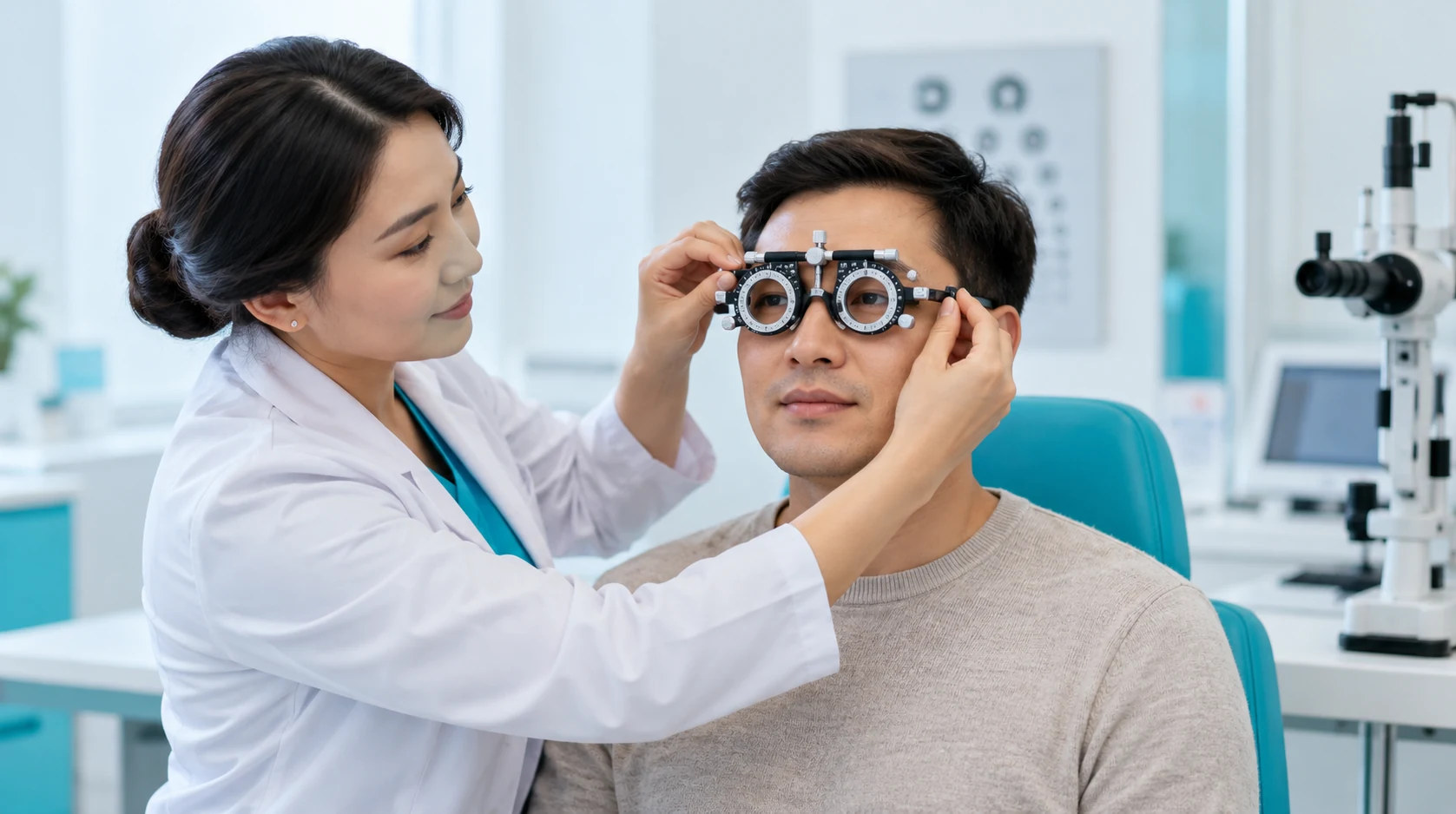
Assessment of cornea, ocular surface, crystalline lens, anterior chamber, pressure and fundus when indicated.
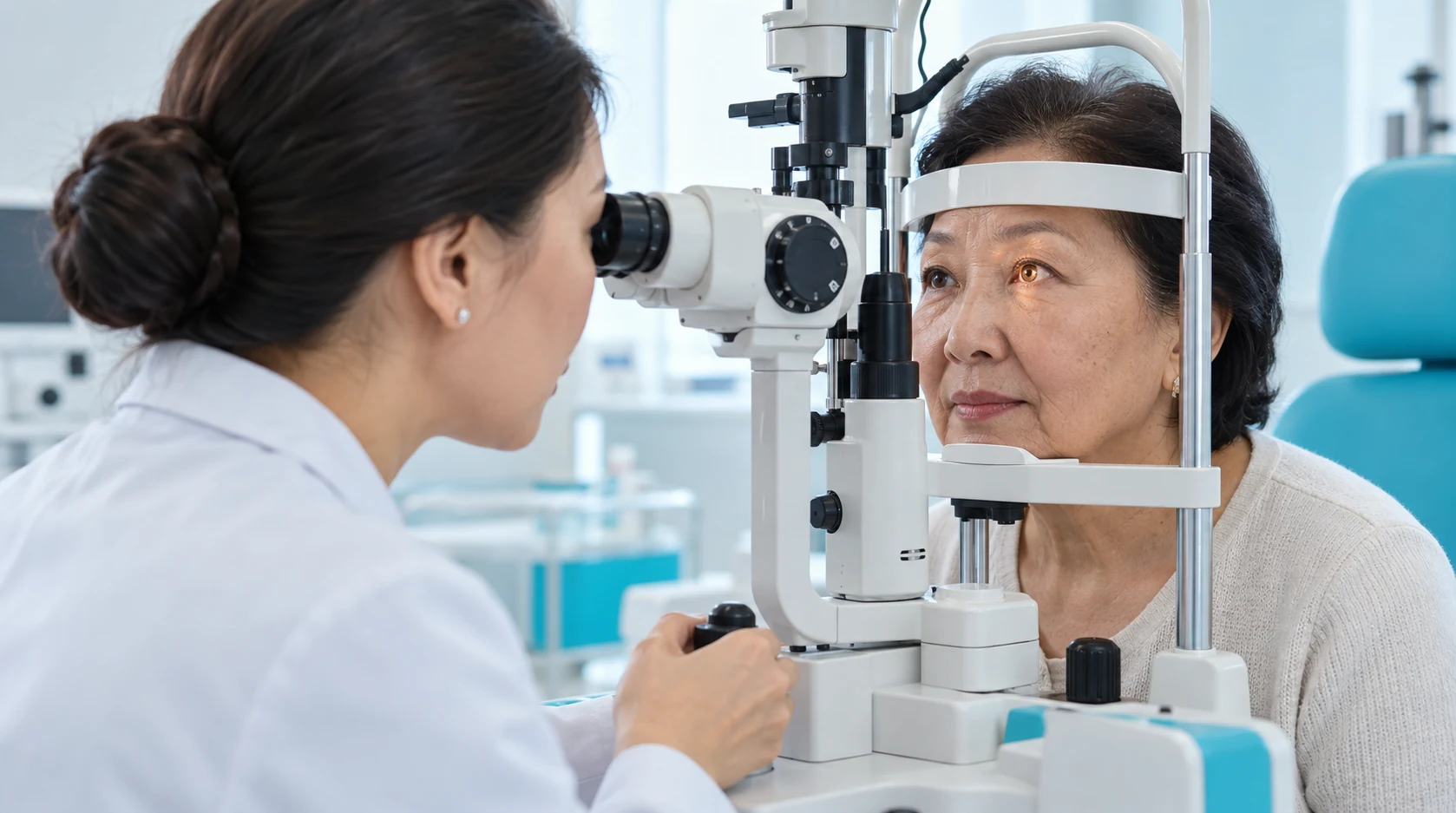
Assessing age and accommodation to avoid promising that laser surgery restores natural near focusing.

Glasses, contact lenses, Femto-LASIK, phakic IOLs or lens surgery according to the clinical situation.
If surgery is selected, the patient receives individual instructions on lenses, tests, medicines and treatment day.

Performed using the selected method.
The doctor assesses visual acuity, residual refraction, cornea or IOL and adjusts postoperative care.

Appropriate hyperopia correction helps reduce excessive focusing effort.
Refraction and accommodation testing help select correction suited to the eye’s focusing characteristics.
The doctor compares visual needs, eye measurements and limitations of different correction options.
Before intervention, the doctor discusses visual goals, limitations and possible need for glasses afterwards.
Book a diagnostic assessment and consultation at KazRIED to establish the full degree of hyperopia and compare correction options. The ophthalmologist will assess refraction, the cornea, natural lens and other relevant parameters and explain whether glasses or contact lenses are sufficient or whether surgery can be considered.
A team of experienced doctors across specialties.

Candidate of Medical Sciences; Highest-category ophthalmologist

Candidate of Medical Sciences; Highest-category ophthalmologist

Candidate of Medical Sciences; Highest-category ophthalmologist

Highest-category ophthalmologist

Highest-category ophthalmologist
Highest-category ophthalmologist

Highest-category ophthalmologist

Highest-category ophthalmologist

Highest-category ophthalmologist

First-category ophthalmologist
Hyperopia is a refractive error in which the eye has insufficient optical power or a relatively short axial length, so without accommodative effort the focal point would lie behind the retina. Younger people can compensate for some hyperopia for years, but near work may trigger eyestrain, headache and blur. With higher hyperopia, both near and distance vision may be reduced.
Correction does not make the eye longer; it changes optical power using spectacles or contact lenses, corneal reshaping or an additional/replacement intraocular lens. The purpose of diagnosis is therefore not only to measure diopters, but to determine which optical strategy best fits the patient.
Additional situations that may change the assessment and treatment plan:
In these situations, the patient may need a separate consultation with a refractive surgeon, cataract surgeon, or pediatric ophthalmologist.
The use of ReLEx SMILE and CLEAR for hyperopia correction at KazRIED requires separate confirmation of the technology and indications. Information about their use for myopia cannot automatically be applied to hyperopia.
If your distance vision is relatively good but your eyes tire quickly when reading, latent hyperopia may be a cause, rather than age-related presbyopia alone.
A young eye can compensate for part of a hyperopic prescription through accommodation for extended periods. A routine vision test may therefore reveal less hyperopia than is actually present.
The diopter value is only one consideration. The clinician assesses:
The same positive prescription in two people may therefore lead to different recommendations.
If the main goal is to reduce dependence on glasses, the first step is to determine whether corneal laser correction is suitable.
For higher hyperopia or age-related changes in the crystalline lens, the clinician may discuss intraocular procedures.
This does not mean that a more complex operation is “better”: the choice depends on the balance of expected benefits and risks.
Age-related changes in vision continue after any surgical correction. Laser treatment does not stop presbyopia, and intraocular surgery has its own limitations.
The decision should therefore follow a comprehensive diagnostic assessment and a discussion of the vision needed at distance, near, and intermediate ranges.
Kazakhstan’s first specialized ophthalmology institute, operating since 1933.
Modern diagnostics and surgery using world-class equipment.
Leading ophthalmologists in Kazakhstan, scientists and experienced surgeons.
More than 30,000 operations and around 270,000 consultations annually.


Kazakhstan’s first specialized ophthalmology institute, operating since 1933.
Modern diagnostics and surgery using world-class equipment.
Leading ophthalmologists in Kazakhstan, scientists and experienced surgeons.
More than 30,000 operations and around 270,000 consultations annually.
Kazakhstan’s first specialized ophthalmology institute, operating since 1933.
Modern diagnostics and surgery using world-class equipment.
Leading ophthalmologists in Kazakhstan, scientists and experienced surgeons.
More than 30,000 operations and around 270,000 consultations annually.


