


Assessment before treatment
The service is appropriate for children and adolescents who need assessment after an abnormal screening result, evaluation of symptoms or follow-up of a known eye condition.
Paediatric ophthalmology assesses visual development, eye health and the need for treatment. Examination is adapted to the child’s age, and recommendations and follow-up are discussed with the parents.
The service is appropriate for children and adolescents who need assessment after an abnormal screening result, evaluation of symptoms or follow-up of a known eye condition.
children who fail vision screening or have risk factors for amblyopia; patients with suspected amblyopia or who have already been prescribed treatment;
children with myopia, hyperopia, astigmatism or anisometropia who need optical correction; vision differs between the eyes, there is high myopia, hyperopia or astigmatism, or the spectacle prescription is changing rapidly;
children with constant or intermittent strabismus or binocular-vision disorders; one eye drifts constantly or intermittently, there is double vision , or the child turns or tilts the head to look;
patients with progressive myopia who need longitudinal assessment and discussion of progression control;
A child should see an ophthalmologist not only when they clearly complain about vision. an infant does not develop stable visual tracking after the first months of life, has an abnormal pupillary reflex, a congenital anomaly or important risk factors;
Some disorders remain unnoticed for a long time, especially when one eye sees better than the other. the child squints, holds a book or screen close, or sits closer to the board or television; the child reports blurred vision , visual fatigue, headache with visual tasks, photophobia or eye pain ; the child was born prematurely or has a condition requiring ophthalmic follow-up;
there is persistent tearing or discharge, recurrent redness or eyelid inflammation;
there has been an eye injury, chemical exposure or sudden loss of vision.
infants and children with congenital or acquired disorders of the eye, lacrimal system, eyelids, retina or optic nerve;
children who require a specialist surgical assessment after consultation.
There are few universal contraindications to a pediatric ophthalmology consultation itself. Limitations mainly apply to individual tests and treatments.
cycloplegic drops are used with consideration of contraindications and individual response;
age and cooperation can limit some subjective tests, so objective or staged assessment may be used;
contact and orthokeratology lenses require strict hygiene and are not suitable for every child;
pleoptic-orthoptic treatment has specific indications and is not a universal method for “improving eyesight”;
surgery is performed only after dedicated diagnostic assessment and review of anaesthetic and surgical risks;
symptoms, history of the condition, visual development, family history, previous prescriptions and use of glasses or contact lenses.
Age-appropriate vision testing and assessment of fixation, tracking, eye alignment and ocular motility.
a routine clinic visit is not a substitute for emergency care after eye trauma, chemical burns or sudden visual loss.
Seek urgent medical care for chemical exposure to the eye, penetrating trauma, sudden marked loss of vision, severe eye pain, an abnormal white pupillary reflex, acute-onset strabismus with neurological symptoms, or other rapidly progressive changes.
A routine clinic visit is not a substitute for emergency care after eye trauma, chemical burns or sudden visual loss.
Book a consultation
Chief complaints, history of present illness, family medical history, prior prescriptions, and current spectacle or contact lens wear regimen.

Age-appropriate vision testing and assessment of fixation, tracking, eye alignment and ocular motility.

The physician determines the examination following cycloplegia.
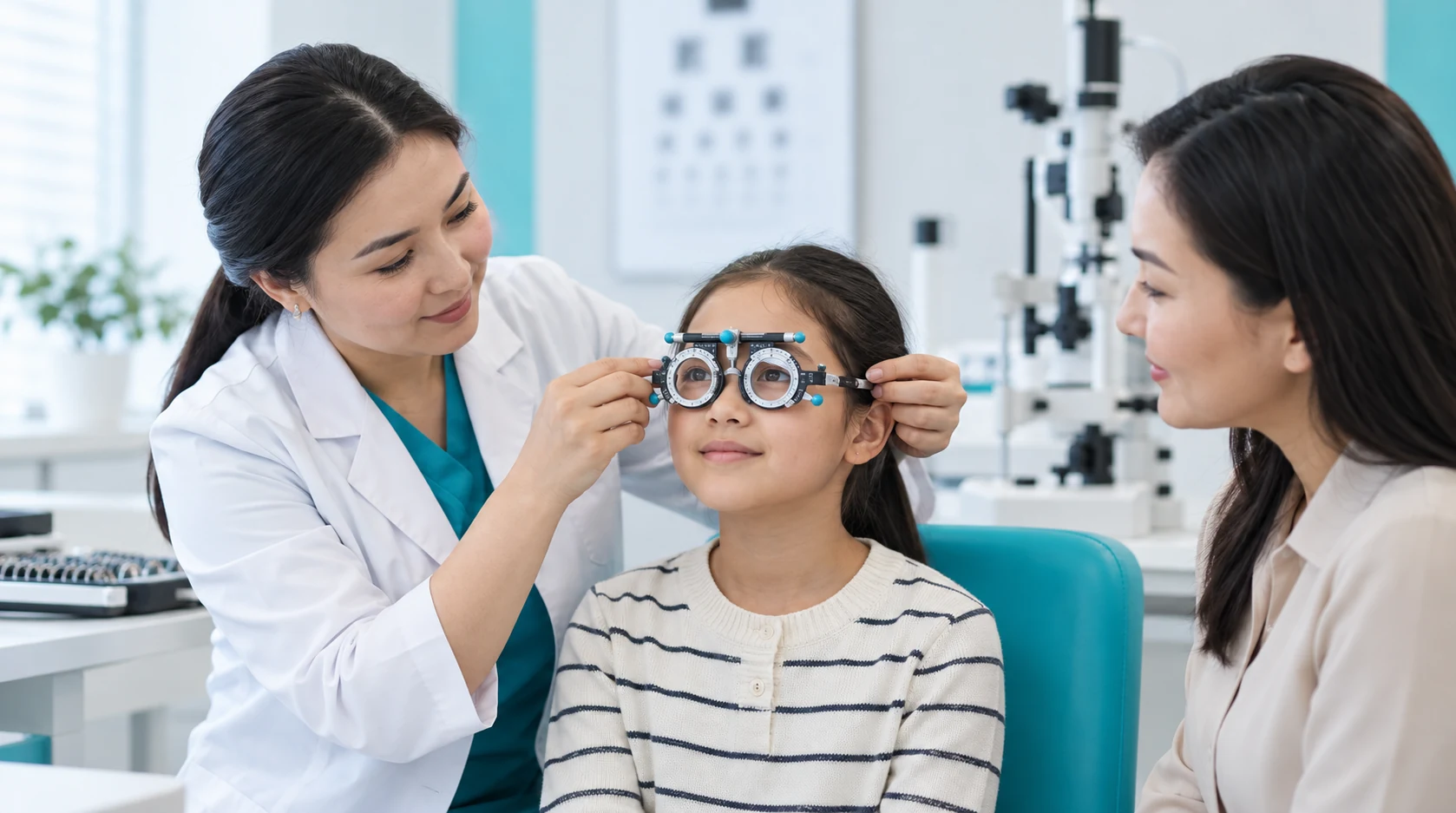
Examination of the anterior segment and fundus, with assessment of pupillary responses.
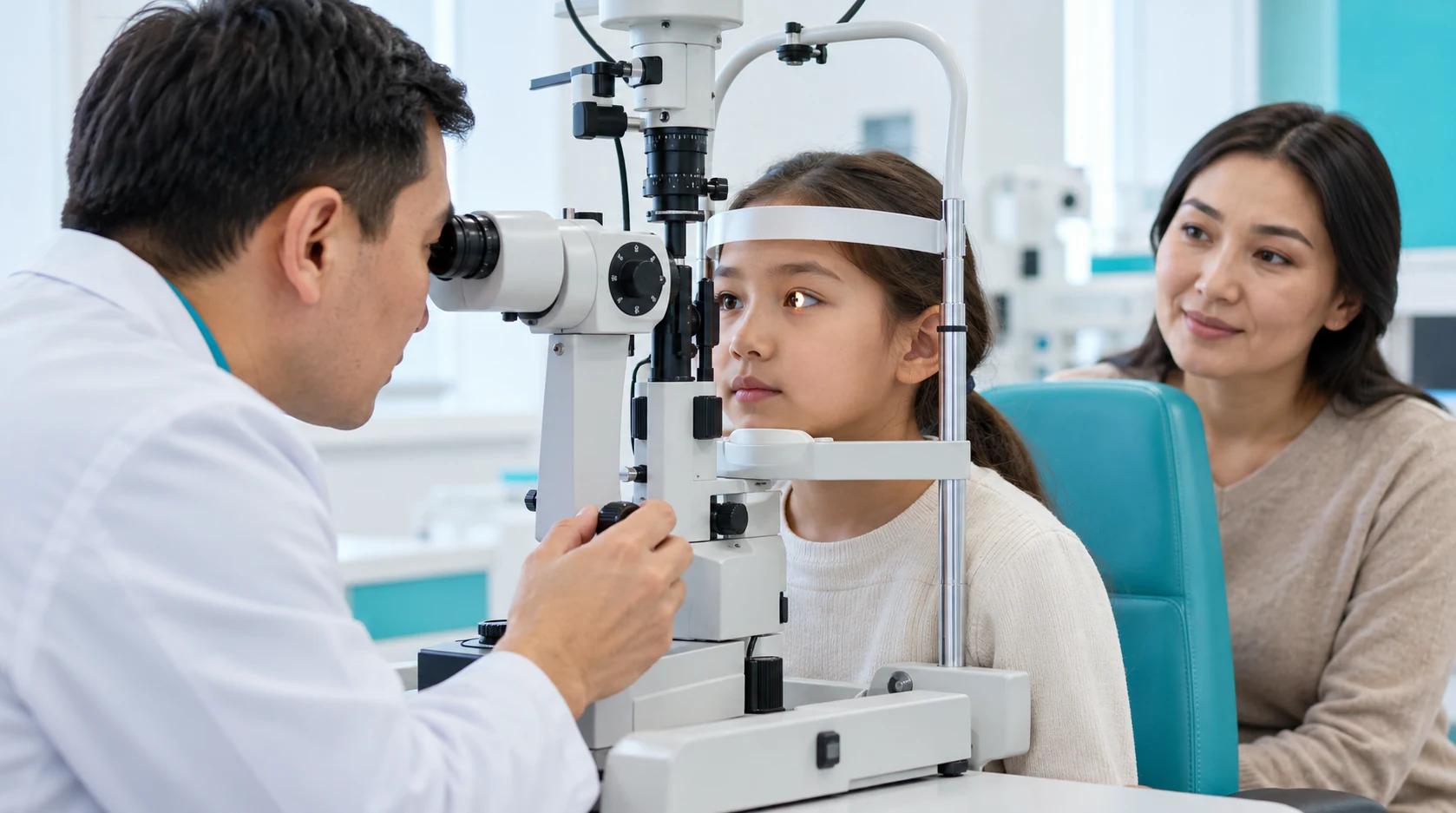
Additional functional or instrumental diagnostics as indicated.
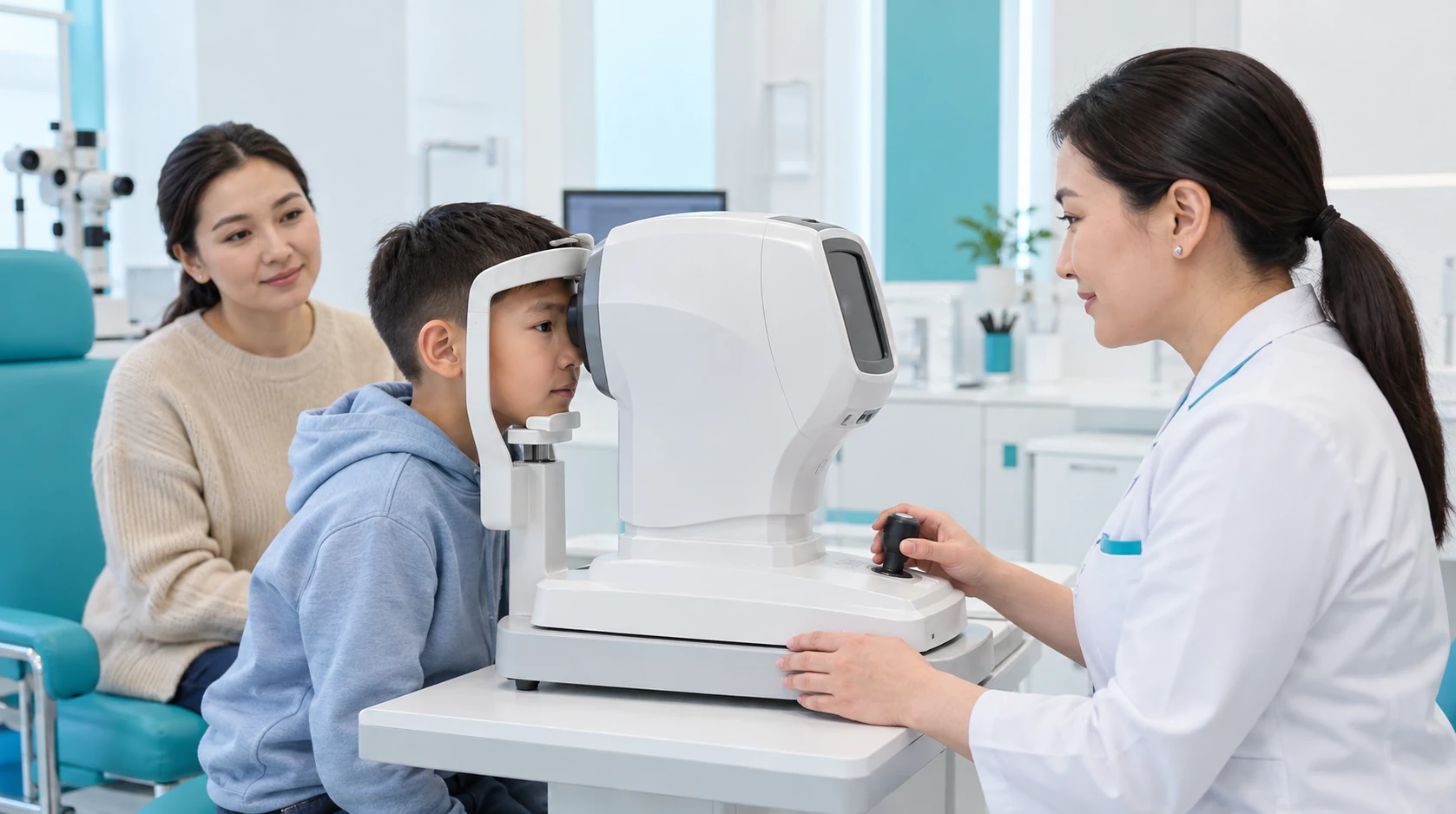
Correction, monitoring, myopia control, amblyopia or strabismus treatment, or surgical referral.
A follow-up schedule is set according to age and the risk of progression.

Vision testing methods are selected for the child's age and abilities to obtain information useful for treatment.
Timely detection and treatment are especially important while the child's visual system is still developing.
The care plan can be adapted as the child grows, refraction changes and the response to treatment becomes clear.
Examination findings help guide correction, treatment procedures and follow-up within one coordinated plan.
Children’s glasses are prescribed according to refraction, visual acuity and binocular function.
Learn moreOvernight orthokeratology lenses temporarily reshape the cornea during sleep.
Learn moreDevice-based treatment is an individual programme of visual exercises for amblyopia and selected binocular vision problems.
Learn moreBook a pediatric ophthalmology consultation at KazRIED to assess your child’s vision, determine whether additional testing is needed, and receive an observation, correction or treatment plan based on the diagnosis.
The price includes intraocular pressure (IOP) measurement and refractometry
Ophthalmologist consultation without diagnostic package
A team of experienced doctors across specialties.

Doctor of Medical Sciences, Associate Professor; Highest-category ophthalmologist
Candidate of Medical Sciences, Associate Professor; Highest-category ophthalmologist

Candidate of Medical Sciences

Candidate of Medical Sciences; Highest-category ophthalmologist
Master’s Student in Public Health

Highest-category ophthalmologist

Highest-category ophthalmologist

Highest-category ophthalmologist

Highest-category ophthalmologist
Highest-category ophthalmologist
A child's vision develops alongside the eyes and the visual centers of the brain. Pediatric ophthalmology therefore assesses not only how well a child sees at present, but also whether refraction, binocular vision and coordination between the two eyes are developing properly.
The most common reasons for consulting a pediatric ophthalmologist include myopia, hyperopia, astigmatism, anisometropia, amblyopia and strabismus. In young children, these conditions may occur without noticeable complaints. One eye may compensate for reduced vision in the other, and the child may not realize that their vision differs from that of other people.
Accurate refraction assessment and timely optical correction are essential in managing refractive errors. In progressive myopia, the ophthalmologist also evaluates changes over time, risk factors and options for controlling progression.
The frequency of follow-up examinations depends on the child's age, diagnosed conditions, changes in refraction and prescribed treatment. Not every child requires the same schedule of comprehensive examinations.
If a child begins squinting and has difficulty seeing the classroom board, visual acuity and refraction should be assessed. Cycloplegia may be performed if necessary, followed by appropriate optical correction. If myopia is identified, the ophthalmologist evaluates its progression and establishes a follow-up schedule.
Vision screening and a comprehensive ophthalmological examination serve different purposes. Screening helps identify children at risk of vision problems. A comprehensive examination is indicated when abnormalities, symptoms, risk factors or an existing eye condition are present. An annual comprehensive ophthalmological checkup should therefore not automatically be required for every healthy child.
Amblyopia is associated with insufficient development of visual function in one or both eyes. Treatment aims to address the underlying cause and improve visual function in the weaker eye.
Depending on the clinical situation, treatment may include appropriate optical correction, patching, other penalization methods, and pleoptic or orthoptic treatment prescribed by an ophthalmologist.
Amblyopia and strabismus are related but distinct conditions. Surgery to correct eye alignment does not replace amblyopia treatment or optical correction when these are necessary.
Children's refraction changes as their eyes grow, and their accommodative ability is strong. In some situations, measuring refraction without cycloplegia may produce inaccurate results. The ophthalmologist determines when pupil dilation and temporary relaxation of accommodation are necessary for accurate optical correction.
Managing progressive myopia involves more than prescribing stronger glasses whenever vision deteriorates. The ophthalmologist evaluates the rate of refractive change and discusses available methods of myopia control.
When a school-aged child's myopia progresses rapidly, previous refraction measurements are compared with current findings. Different myopia-control options, including orthokeratology for suitable patients, may be considered. Regular monitoring is required.
The scope of the examination depends on the child's age, symptoms, identified conditions and ability to perform diagnostic tests. The same set of investigations is not necessary for every patient.
A standard pediatric examination progresses from simple age-appropriate tests to more specialized investigations. The exact sequence may vary.
After reviewing the findings, the ophthalmologist determines the appropriate next steps: observation, glasses or contact lenses, amblyopia treatment, a pleoptic or orthoptic treatment program, myopia control or consultation with an eye surgeon.
An initial pediatric ophthalmology consultation in Almaty includes reviewing symptoms and medical history, measuring uncorrected and corrected visual acuity, autorefraction, and assessing objective and subjective refraction.
The consultation also includes binocular vision assessment, functional tests, biomicroscopy, fundus examination and refraction assessment under cycloplegia.
If necessary, the ophthalmologist prescribes glasses, establishes a diagnosis and provides recommendations for further monitoring or treatment.
Measurement of the eye's axial length (anteroposterior axis) for myopia monitoring is charged separately. When booking, patients should confirm which additional diagnostic investigations are included in the consultation and which require separate payment.
When examining a child with strabismus, the ophthalmologist assesses refraction, visual acuity in each eye, binocular vision and the angle of deviation. Conservative treatment may be sufficient for some children, while others may require surgical correction.
The treatment pathway involves accurate refraction assessment, optical correction, treatment of amblyopia and binocular vision disorders, surgery when indicated, and subsequent follow-up.
KazRIED has a pediatric department and provides specialized ophthalmic surgical care. Children with congenital cataracts, retinopathy of prematurity, complex retinal disorders and other conditions requiring surgery are referred to the appropriate specialist rather than managed through a standard pediatric consultation pathway.
Certain changes in a child's vision or eye condition require urgent assessment rather than a routine appointment.
If an infant repeatedly shows a white pupillary reflex or has congenital clouding of the ocular media, urgent specialist assessment is necessary. After specialized diagnostic evaluation, the child may be referred to a pediatric ophthalmic surgical department if required.
An unusual pupillary reflex, eye injury, sudden loss of vision or acute eye inflammation also requires prompt in-person medical evaluation. In these situations, parents should not wait for a routine examination or a scheduled course of vision therapy.
Kazakhstan’s first specialized ophthalmology institute, operating since 1933.
Modern diagnostics and surgery using world-class equipment.
Leading ophthalmologists in Kazakhstan, scientists and experienced surgeons.
More than 30,000 operations and around 270,000 consultations annually.


Kazakhstan’s first specialized ophthalmology institute, operating since 1933.
Modern diagnostics and surgery using world-class equipment.
Leading ophthalmologists in Kazakhstan, scientists and experienced surgeons.
More than 30,000 operations and around 270,000 consultations annually.
Kazakhstan’s first specialized ophthalmology institute, operating since 1933.
Modern diagnostics and surgery using world-class equipment.
Leading ophthalmologists in Kazakhstan, scientists and experienced surgeons.
More than 30,000 operations and around 270,000 consultations annually.


