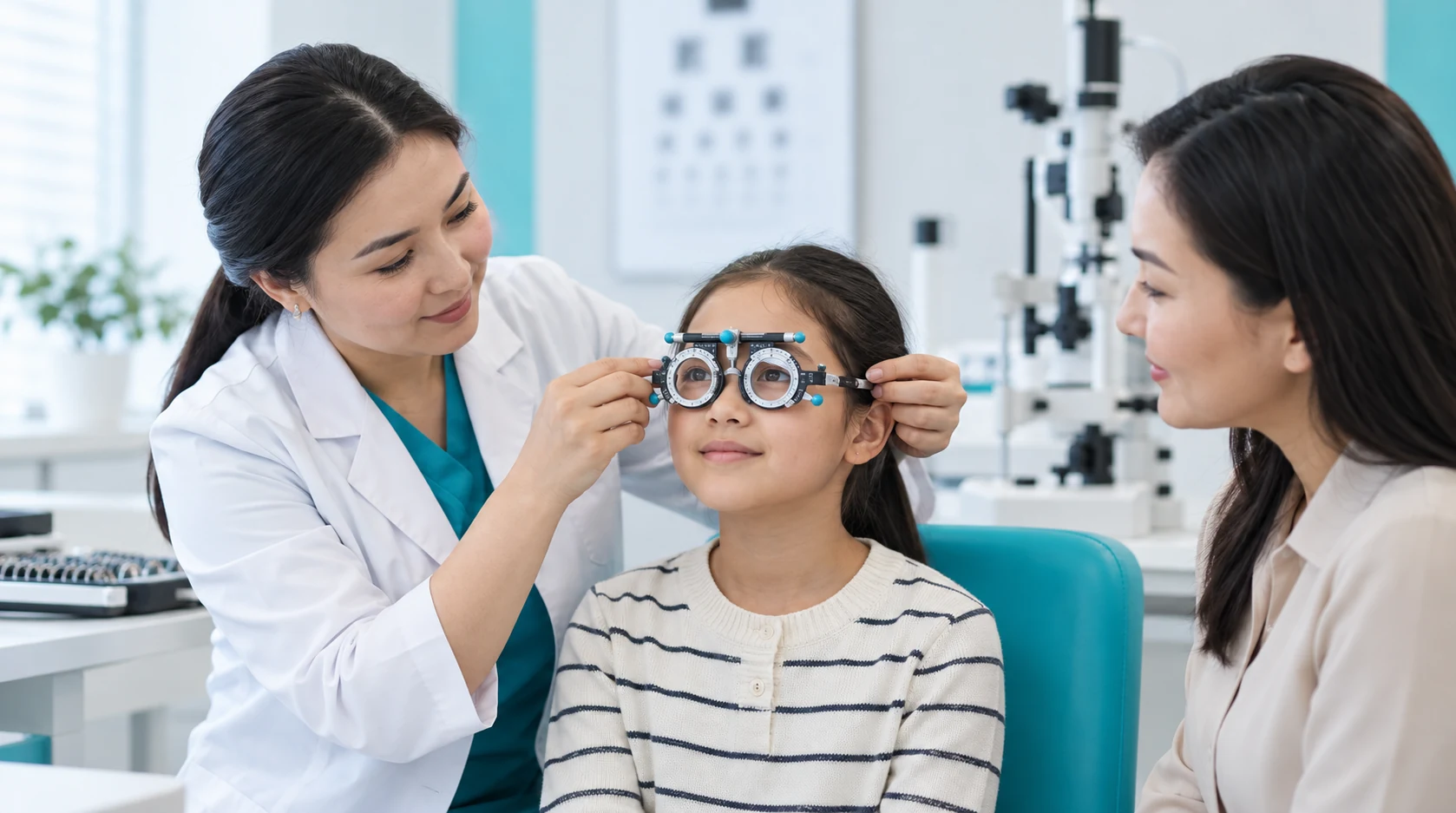
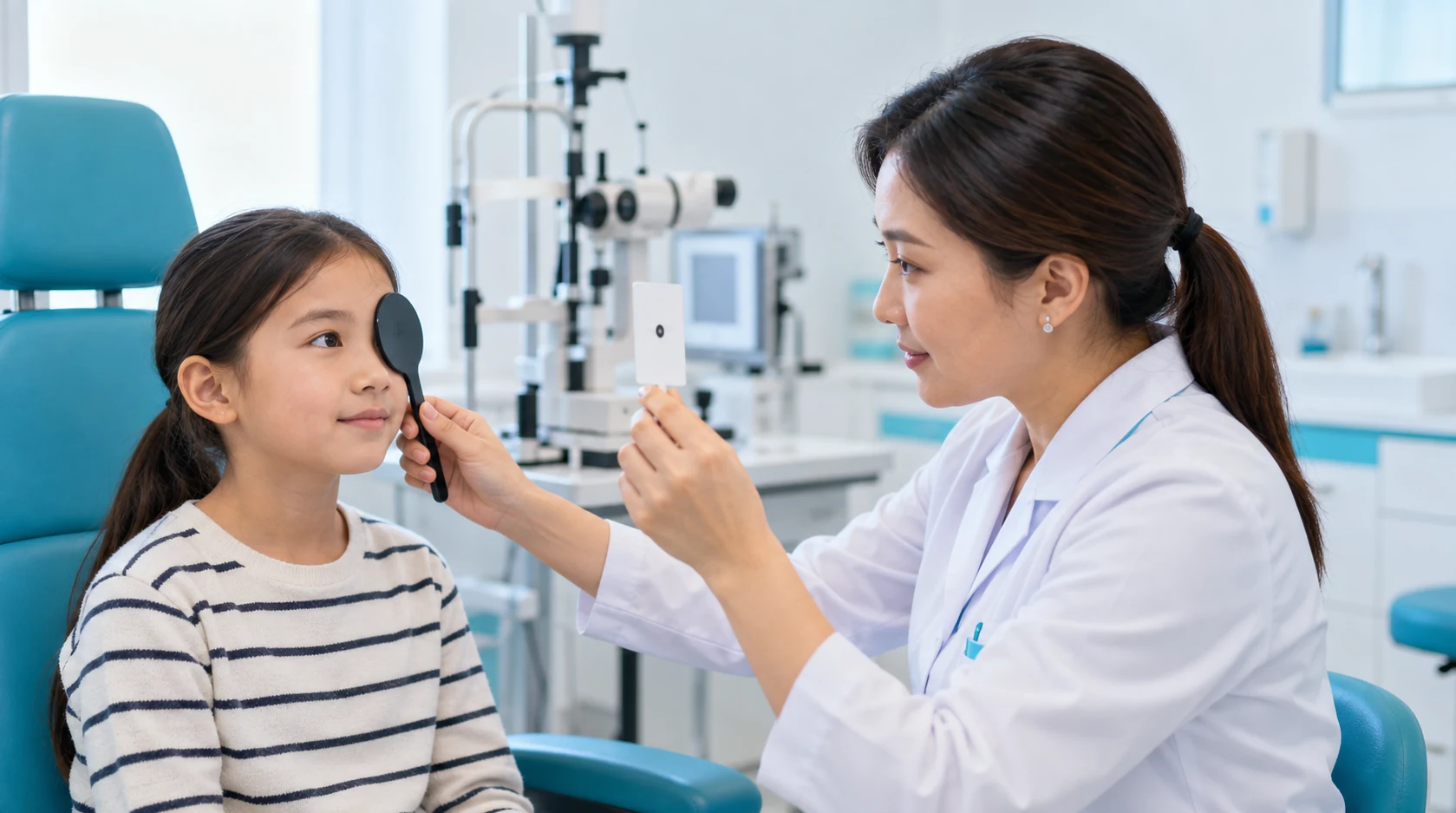
Strabismus is a condition in which the eyes are not properly aligned. In children, it can affect not only appearance but also visual development. When the brain receives conflicting images from the two eyes, it may suppress the image from one eye. This increases the risk of amblyopia, a reduction in vision associated with abnormal visual development.
Strabismus treatment has several objectives: to provide the clearest possible image for each eye, improve vision in the weaker eye, achieve appropriate eye alignment and create conditions for both eyes to work together.
The treatment approach depends on the type of strabismus, the child's age, refraction, the presence of amblyopia and the ability to use both eyes together. In some cases, optical correction is sufficient, while others require a combination of treatments, including surgery.
Strabismus Diagnosis and Treatment Planning
The ophthalmologist first determines whether the child has strabismus and identifies its type. Strabismus may be convergent, divergent, vertical, constant or intermittent. It may also be classified as accommodative, partially accommodative, non-accommodative or another form based on its underlying mechanism.
To select an appropriate treatment, the ophthalmologist assesses visual acuity in each eye, refraction, with cycloplegia when indicated, eye movement functions, and the angle of deviation at different distances and in different directions of gaze. The examination also evaluates the presence of amblyopia, binocular fusion and stereoscopic vision.
Similar visible eye deviations can have different underlying causes. Treatment should therefore not be selected solely on the appearance of the deviation or a single measurement of its angle.
In unusual or sudden-onset strabismus, the ophthalmologist determines whether additional investigations, including neurological assessment, are necessary.
At KazRIED, the treatment sequence is determined after a comprehensive assessment of the child's visual and eye movement functions.
Methods of Strabismus Treatment in Children
The choice of treatment depends on the cause and type of strabismus, visual function and diagnostic findings. Treatment may involve several methods used sequentially or in combination.
- Glasses and optical correction. Glasses are particularly important in accommodative esotropia and significant refractive errors. In some children, correctly prescribed glasses can substantially reduce the angle of deviation without surgery. Full optical correction may remain the primary treatment for accommodative strabismus.
- Amblyopia treatment. When vision is reduced in one eye, the ophthalmologist may prescribe patching of the stronger eye or other penalization methods to encourage use of the weaker eye. The treatment schedule is individualized because excessive or incorrectly prescribed patching may have undesirable effects.
- Orthoptic and diploptic treatment. These methods are used to train specific binocular functions when the intended clinical objective is achievable. Exercises and treatment schedules are prescribed by the ophthalmologist.
- Prismatic correction. Prism lenses may be considered for certain types of strabismus based on examination findings.
- Surgical treatment. Some forms of strabismus require surgery on the extraocular muscles to modify the balance of muscle actions and improve eye alignment.
Strabismus surgery and amblyopia treatment address different problems. Surgery changes eye alignment but does not automatically treat amblyopia or guarantee the development of stereoscopic vision. Optical correction and functional treatment may therefore be needed before and after surgery.
Computer-Based Strabismus Treatment
Computer-based strabismus treatment is a functional treatment method prescribed by an ophthalmologist when indicated. It may be used as part of orthoptic or diploptic treatment to address specific binocular functions.
Computer-based treatment is charged as a separate procedure. The ophthalmologist determines whether it is required.
Additional Recommendations and Common Situations
- A 3-year-old child begins turning one eye inward toward the nose. The ophthalmologist assesses refraction under cycloplegia and measures the angle of deviation. If significant hyperopia is present, glasses may be the first treatment. The residual deviation and binocular functions are then reassessed.
- A school-aged child's eye turns, and vision in that eye is poorer. The ophthalmologist first confirms whether amblyopia is present and identifies the cause of reduced vision. Optical correction and amblyopia treatment are prescribed when indicated, followed by assessment of eye alignment and binocular rehabilitation.
- Intermittent exotropia appears only when the child is tired. The ophthalmologist assesses how often the deviation occurs, the child's ability to control eye alignment, stereoscopic vision and the angle of deviation. Observation may be appropriate when control is good. Deteriorating control may require active treatment or surgical consultation.
- The eyes remain noticeably misaligned despite wearing glasses. The ophthalmologist measures the residual deviation while the child is wearing the correct prescription and determines whether extraocular muscle surgery is indicated.
- Strabismus develops suddenly and is accompanied by double vision. This requires urgent ophthalmological assessment and, when indicated, neurological examination. The child should not wait for a routine course of vision therapy.
When Is Strabismus Surgery Necessary?
Surgical correction is considered for forms of strabismus in which conservative treatment is insufficient to achieve the necessary eye alignment or when other surgical indications are present.
In accommodative strabismus, the ophthalmologist first evaluates the response to correctly prescribed glasses. The decision regarding surgery may depend on the residual deviation while wearing the appropriate correction.
The decision to operate is not based solely on the angle of strabismus or the child's age. The ophthalmologist considers the type of deviation, vision in each eye, binocular functions, previous treatment results and changes over time.
After surgery, amblyopia treatment, optical correction and functional rehabilitation may continue when necessary.
Why Early Strabismus Treatment Matters
Early detection and treatment are particularly important while the visual system is developing. However, there is no universal age limit after which treatment becomes ineffective.
According to the American Association for Pediatric Ophthalmology and Strabismus (AAPOS), amblyopia generally responds better to treatment at younger ages, although visual improvement is also possible in some adolescents.
Even when strabismus or amblyopia is detected later in childhood, an ophthalmological examination is still necessary. The doctor assesses visual function and determines which correction and treatment options may be appropriate.
Monitoring Treatment Results
Strabismus treatment requires ongoing follow-up. During review appointments, the ophthalmologist compares visual acuity in each eye, the angle of deviation, the child's ability to control eye alignment and binocular functions.
Follow-up visits are needed not only to evaluate treatment results but also to adjust the treatment plan if the child's visual system responds differently than expected.
The treatment sequence is individualized: optical correction, amblyopia treatment, observation, orthoptic methods, surgery when indicated, or a combination of these approaches.