

Laser Trabeculoplasty
Laser trabeculoplasty improves natural aqueous outflow and helps lower eye pressure.
Learn moreLaser trabeculoplasty improves natural aqueous outflow and helps lower eye pressure.
Learn moreLaser treatment lowers eye pressure through different mechanisms. The procedure depends on glaucoma type, anterior chamber angle anatomy and the treatment goal.
Primary open-angle glaucoma or ocular hypertension when SLT is considered appropriate for IOP reduction.
Insufficient effect, intolerance or adherence difficulties with pressure-lowering eye drops.
Narrow or closing angle with confirmed pupillary block when laser iridotomy is indicated.
Need for additional IOP lowering after previous therapy or surgery when ocular anatomy allows laser treatment.
Complex or refractory glaucoma when micropulse ciliary-body treatment is being considered.
Laser is not a cure that reverses glaucoma and it does not restore already lost visual field. Drops or glaucoma surgery may still be needed after SLT or iridotomy. Possible adverse effects include transient IOP rise, inflammation, discomfort and blur; iridotomy can also cause dysphotopsia, iris bleeding or require repeat treatment if the opening is not adequate.
The patient is willing to continue follow-up after laser and understands that the procedure does not replace glaucoma monitoring.
Bring your latest glaucoma results: intraocular pressure, gonioscopy, optic nerve/RNFL OCT, visual fields, pachymetry and records of previous operations. Do not stop pressure-lowering drops on your own. Tell the doctor about inflammatory eye disease, injuries, operations, steroid use, pregnancy, medicine allergies and systemic conditions.
The ophthalmologist or laser surgeon determines the exact tests required before laser treatment.
Laser is not a cure that reverses glaucoma and it does not restore already lost visual field. Drops or glaucoma surgery may still be needed after SLT or iridotomy. Possible adverse effects include transient IOP rise, inflammation, discomfort and blur; iridotomy can also cause dysphotopsia, iris bleeding or require repeat treatment if the opening is not adequate. Severe pain, marked redness, sudden vision loss, nausea or vomiting require urgent clinical assessment.
Book a consultation
Glaucoma type, stage, target pressure and changes in the optic nerve and visual field.

An open, narrow or closed angle and the blockage mechanism are confirmed.
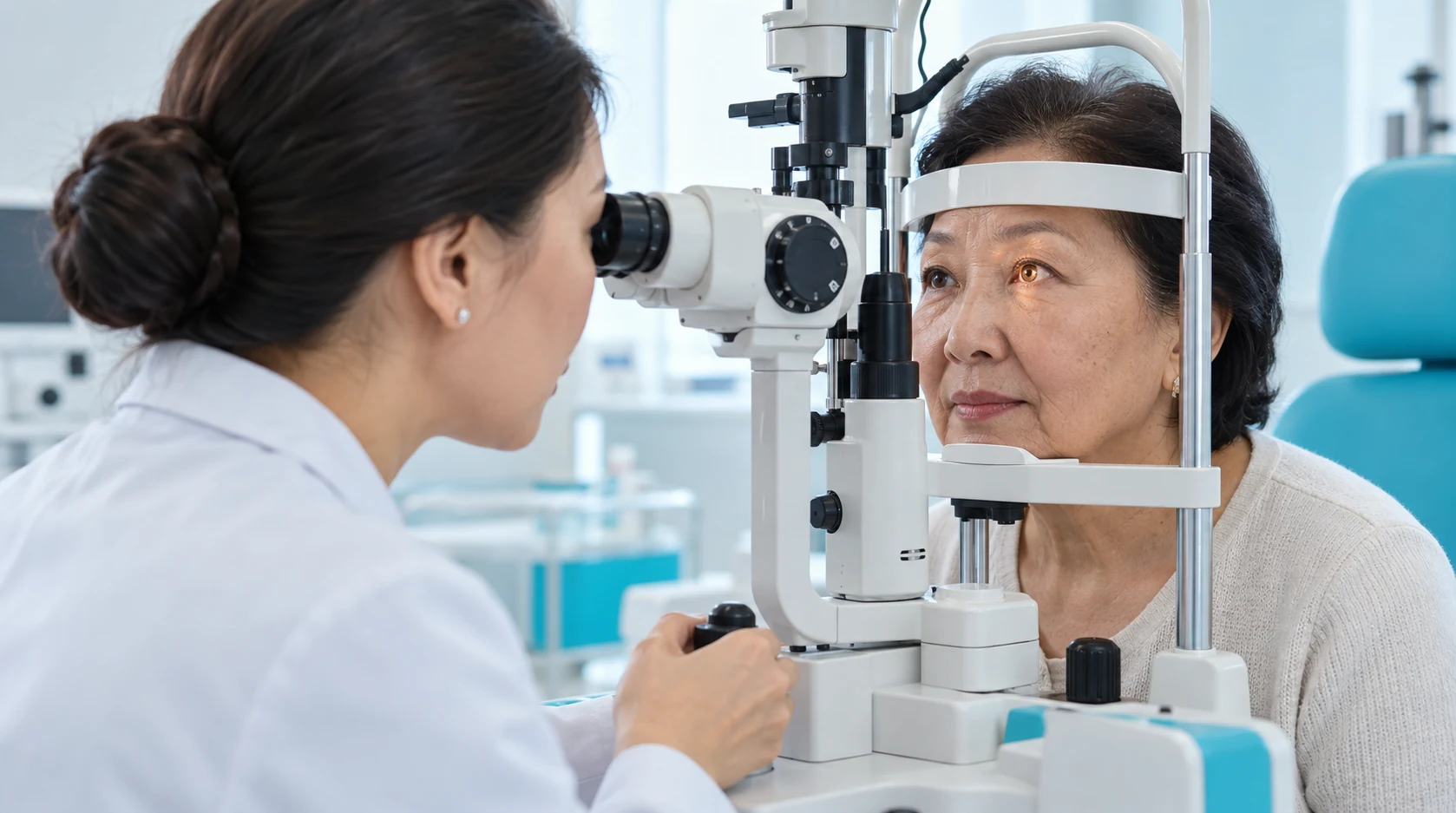
Pressure measurement and other indicated tests; medicines change only on the doctor's instructions.

Topical anaesthesia and placement of a special gonio/laser lens when required.

SLT to the trabecular meshwork, peripheral iris iridotomy or another selected method.
The doctor assesses the eye and pressure if needed after treatment.

Drops and the regimen are individualised; do not change pressure-lowering therapy yourself.
Pressure, optic nerve and visual fields are monitored over time; effectiveness is not determined only by pressure on treatment day.
Reaching the target pressure helps reduce the risk of further optic nerve damage.
Laser treatment can be performed without a standard surgical incision into the eyeball.
The laser technique is selected according to drainage angle anatomy and the cause of raised pressure.
Many laser procedures are performed without hospital admission; the doctor determines the setting and follow-up.
Book a consultation for laser glaucoma treatment at KazRIED. The ophthalmologist will assess angle anatomy, target IOP, optic-nerve status and previous treatment before deciding whether SLT, iridotomy or another laser procedure is appropriate.
A team of experienced doctors across specialties.

Candidate of Medical Sciences; Highest-category ophthalmologist
Highest-category ophthalmologist
Highest-category ophthalmologist

Highest-category ophthalmologist

Second-category ophthalmologist

PhD Student

Laser treatments for glaucoma work through different mechanisms. The procedure is selected according to the disease mechanism and the eye’s anatomy.
The choice depends on gonioscopy findings, glaucoma stage, target intraocular pressure (IOP), optic nerve condition, previous treatment, and the eye’s anatomy.
Laser treatment does not restore optic nerve fibers that have already been lost. The goal is to lower IOP to an individualized target and reduce the risk of further progression.
Even a good response to laser treatment does not remove the need for continued IOP monitoring, OCT examinations, and visual field testing.
Laser treatment is selected according to the specific disease mechanism. A simple comparison suggesting that “laser is better than drops” does not reflect all the factors involved in choosing treatment.
International guidelines recognize selective laser trabeculoplasty (SLT) as an initial treatment option for suitable patients with uncomplicated chronic open-angle glaucoma or ocular hypertension.
The clinician determines whether pupillary block is present and whether laser iridotomy would provide a pathway for aqueous humor flow.
KazRIED has a specialized Kazakhstan-German Glaucoma Center and a laser department.
This allows the decision about laser treatment to be integrated with a comprehensive glaucoma assessment and subsequent follow-up. The procedure should be accompanied by continued monitoring of the eye.
Related information: Kazakhstan-German Glaucoma Center.
Kazakhstan’s first specialized ophthalmology institute, operating since 1933.
Modern diagnostics and surgery using world-class equipment.
Leading ophthalmologists in Kazakhstan, scientists and experienced surgeons.
More than 30,000 operations and around 270,000 consultations annually.


Kazakhstan’s first specialized ophthalmology institute, operating since 1933.
Modern diagnostics and surgery using world-class equipment.
Leading ophthalmologists in Kazakhstan, scientists and experienced surgeons.
More than 30,000 operations and around 270,000 consultations annually.
Kazakhstan’s first specialized ophthalmology institute, operating since 1933.
Modern diagnostics and surgery using world-class equipment.
Leading ophthalmologists in Kazakhstan, scientists and experienced surgeons.
More than 30,000 operations and around 270,000 consultations annually.


