Orthokeratology is a method of temporary vision correction using specially designed rigid gas-permeable contact lenses that are inserted before sleep and removed in the morning. Overnight, the lenses modify the profile of the corneal surface epithelium, allowing the child to see clearly during the day without regular glasses or daytime contact lenses.
The effect of orthokeratology involves redistribution of epithelial cells and the action of the tear film beneath the lens, rather than simple mechanical pressure. When regular lens wear is discontinued, the cornea gradually returns to its original shape. The optical effect of overnight lenses is reversible and requires regular use.
In children, orthokeratology serves two different purposes: providing daytime vision without glasses and potentially controlling myopia progression. Clear vision after removing the lenses does not mean that nearsightedness has stopped progressing.
According to the International Myopia Institute (IMI 2025), orthokeratology is among the most extensively studied methods of myopia control. Randomized studies have demonstrated a consistent effect in slowing axial eye elongation compared with standard single-vision glasses. However, the response varies between individuals, and complete cessation of progression cannot be guaranteed.
How Overnight Orthokeratology Lenses Work
The child inserts orthokeratology lenses before going to sleep and removes them in the morning. During sleep, the lenses temporarily reshape the superficial layer of the cornea, producing an optical effect that allows the child to function without conventional vision correction during the day.
Overnight orthokeratology lenses are not ordinary contact lenses that can simply be left in during sleep. They have a specialized design and require individualized fitting and regular monitoring of corneal health.
The range of refractive correction depends on the specific lens design, corneal parameters and examination results. The ophthalmologist assesses age-related indications, eligible refractive ranges and the expected effect individually.
How Orthokeratology Lenses Are Fitted
Orthokeratology fitting is more complex than standard contact lens correction. It requires confirmation of refraction, assessment of the cornea and ocular surface, appropriate measurements, selection of lens design and evaluation of lens fit.
- Pediatric ophthalmology consultation. The ophthalmologist confirms myopia and assesses refraction. When necessary, measurements are repeated under cycloplegia, which temporarily relaxes accommodation using medication.
- Ocular surface examination. The cornea, eyelids, tear film and anterior segment of the eye are assessed.
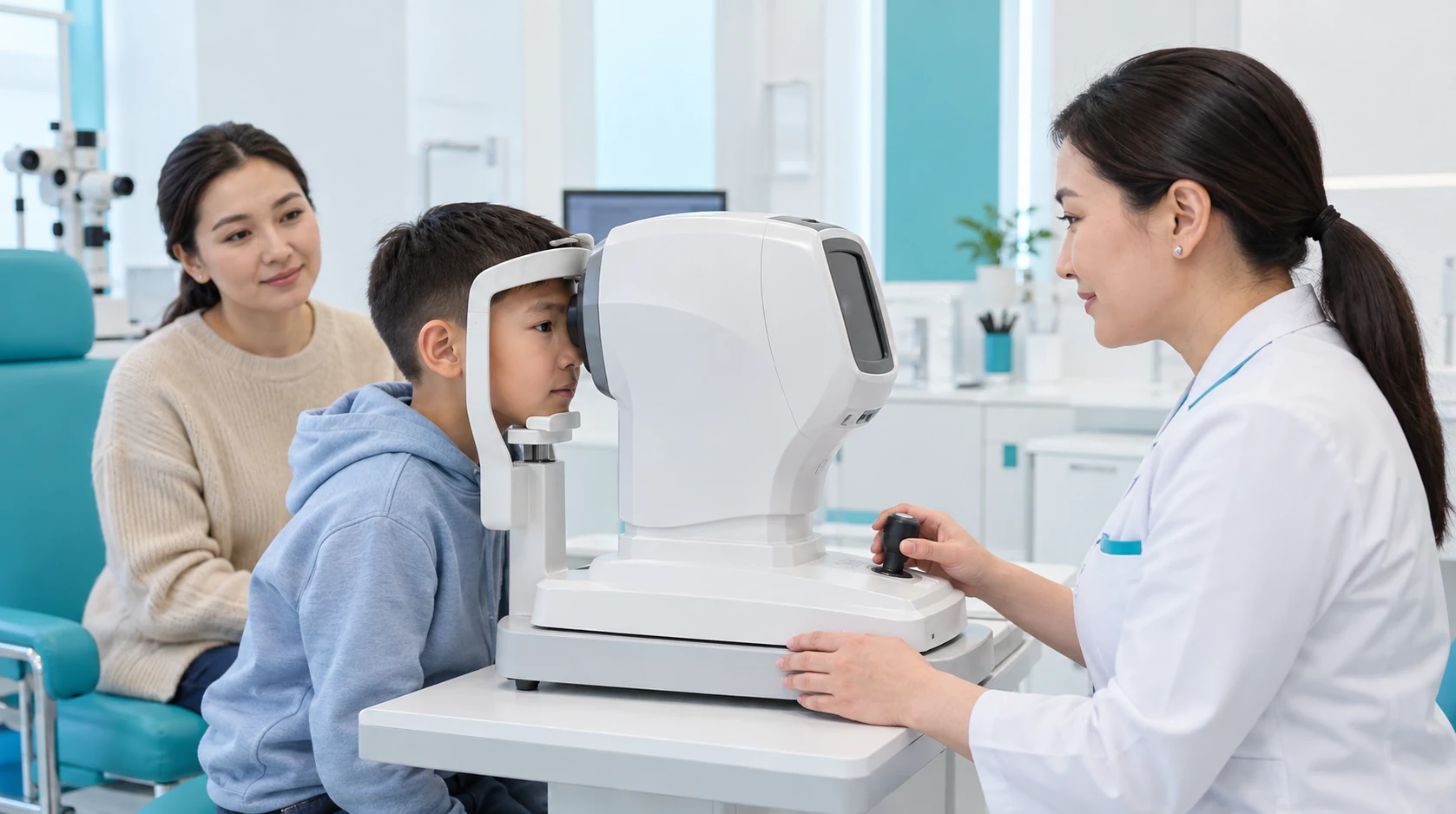
- Keratometry and corneal topography. These investigations measure corneal curvature, symmetry and shape. The results help determine lens parameters and provide reference maps for comparison during follow-up visits.
- Lens design selection and trial fitting. The ophthalmologist selects an appropriate orthokeratology lens and evaluates its position and centration.
- Training for the child and parents. Instructions cover lens insertion, removal, cleaning and storage, hygiene requirements and actions to take if warning symptoms develop.
- First night and early follow-up. After lens wear begins, the ophthalmologist checks visual quality, lens fit and corneal condition. Further follow-up examinations are then scheduled.
Corneal geometry is particularly important in orthokeratology. Keratometry and topography allow the ophthalmologist to assess baseline corneal parameters and monitor changes associated with lens wear.
The diagnostic pathway described by KazRIED includes refractometry, keratometry and corneal examination using Pentacam. The ophthalmologist determines which investigations are necessary.
Orthokeratology and Myopia Progression Control
Orthokeratology is considered one of the methods for slowing myopia progression in children. On average, studies show reduced axial eye elongation compared with conventional single-vision spectacle correction.
To assess progression, the ophthalmologist considers the age of myopia onset, previous prescriptions, the rate of refractive change and, when available, repeated axial length measurements.
The effectiveness of myopia control is not assessed solely by daytime visual quality. It is important to monitor changes in refraction and determine whether eye growth is slowing over the longer term.
Good visual acuity after the first week of lens wear demonstrates an optical effect but does not establish the effectiveness of myopia progression control. Repeated measurements and long-term monitoring are necessary.
Additional Recommendations and Common Situations
- A child wants to try overnight lenses for the first time. The ophthalmologist confirms myopia, examines the cornea and tear film, and performs keratometry and corneal topography. Lens design is selected, trial fit is assessed, the child and parents receive training, and an early follow-up visit is arranged after lens wear begins.
- Myopia continues to progress despite regular glasses. Previous prescriptions and, when available, axial length measurements are compared. The ophthalmologist discusses myopia-control options, evaluates corneal suitability for orthokeratology and, if this method is selected, performs fitting followed by long-term monitoring.
- The child has astigmatism. Corneal topography is performed, and the degree and type of astigmatism are assessed. A standard, toric or customized orthokeratology lens is selected as appropriate, with subsequent monitoring of lens centration.
- Daytime vision is unstable after the first night. The ophthalmologist checks lens fit and corneal topography, reviews proper insertion technique and evaluates sleep duration. Lens parameters may be adjusted if necessary.
- The eye is red and painful in the morning. The lens must be removed immediately, lens wear discontinued, and an urgent ophthalmological examination arranged to rule out keratitis or corneal injury.
- The family is choosing between orthokeratology and specialized glasses. The ophthalmologist compares expected effectiveness, risks, hygiene requirements, sports activities, cost and the child's ability to follow the prescribed routine. The choice is made together with the family.
Orthokeratology Lens Models
The specific orthokeratology lens model is prescribed by the ophthalmologist based on corneal examination, refraction assessment and individualized fitting.
- OKVision OK spherical, Dk 100. The specific model is selected by the ophthalmologist.
- OKVision OK toric, Dk 100. Toric lens design.
- OKVision OK toric, Dk 125. Toric lens design.
Safety and Overnight Lens Care
The safety of orthokeratology depends not only on the lens material but also on accurate fitting, proper hygiene and regular medical follow-up.
Hands must be thoroughly washed and completely dried before handling lenses. Only the prescribed lens care system should be used for cleaning and storage. Contact between water and the lenses or lens case must be avoided. The child should also have an up-to-date pair of backup glasses.
If pain, redness, light sensitivity or reduced vision develops, the lens should be removed, lens wear discontinued and an ophthalmologist consulted. These symptoms should not be left until the next scheduled examination.
Before treatment begins, the ophthalmologist evaluates whether the child and parents can consistently follow daily lens care instructions and attend follow-up appointments. If the family cannot reliably meet these requirements, a simpler correction method may be safer, even when orthokeratology is technically possible.
Monitoring Results and Follow-up Care
A series of follow-up examinations is necessary after orthokeratology lenses have been fitted. The ophthalmologist checks visual acuity, lens position and centration, corneal health and changes in corneal topography.
When orthokeratology is used for myopia progression control, changes in refraction and, where possible, axial eye length are also monitored.
Clear daytime vision and slowing myopia progression are two different outcome measures. Neither should be assessed solely from the child's experience during the first few nights of lens wear.
Orthokeratology does not guarantee complete cessation of myopia progression. Regular follow-up helps evaluate treatment effectiveness and allows timely adjustments to lens parameters or the ongoing management strategy.