

Corneal thickness
Patients before laser correction, with suspected keratoconus or other corneal disease, with glaucoma or ocular hypertension requiring central-thickness assessment, after corneal surgery, and when monitoring over time is needed.
Pachymetry measures corneal thickness. The measurements inform corneal assessment, interpretation of eye pressure and planning of selected procedures.
Patients before laser correction, with suspected keratoconus or other corneal disease, with glaucoma or ocular hypertension requiring central-thickness assessment, after corneal surgery, and when monitoring over time is needed.
If there is acute pain, trauma, marked inflammation or an epithelial defect, clinical examination should precede any contact test.
Pachymetry may be ordered for reduced vision, image distortion, photophobia, recurrent oedema or other symptoms when the doctor suspects corneal disease. Symptoms alone are not an indication specifically for pachymetry.
Keratoconus and other ectasias, corneal dystrophy or oedema, post-cross-linking/keratoplasty states, refractive-surgery screening, glaucoma and ocular hypertension.
Different technologies are not identical. Opacity, marked irregularity, poor fixation, tear-film issues, contact lenses and postoperative changes can affect quality.
Fresh corneal trauma, severe pain, sudden vision loss, chemical injury, purulent discharge or marked redness require urgent clinical assessment rather than a stand-alone scheduled pachymetry test. CCT does not diagnose glaucoma and does not replace tonometry, OCT, visual fields or gonioscopy. Do not mechanically correct IOP using an arbitrary CCT formula.
A universal “normal” thickness must not be used without considering the device, measurement area and clinical context.
Measurements from different devices may have systematic differences and may not be interchangeable.
Before laser correction, thickness alone is insufficient: corneal shape and other parameters must also be assessed.
Fasting and pupil dilation are usually unnecessary for pachymetry itself. If pachymetry is performed before laser correction or to assess keratoconus, the doctor must confirm the exact lens-free interval.
Usually minimal. Remove contact lenses; refractive-surgery protocols may require a longer lens-free period. Remove contact lenses before the test.
Bring previous pachymetry maps, topography or tomography and tonometry results: comparable tests are important for monitoring.
Report previous LASIK, PRK, SMILE, cross-linking, keratoplasty, injuries and corneal disease.
Pachymetry does not diagnose keratoconus by itself.
Book a consultation
The specialist clarifies the goal: corneal assessment, glaucoma, surgery preparation or monitoring.
Takes: 1 min

Contact lenses are removed.
Takes: 1 min

The patient fixates while the device scans or the specialist takes a point measurement.
Takes: 1 min
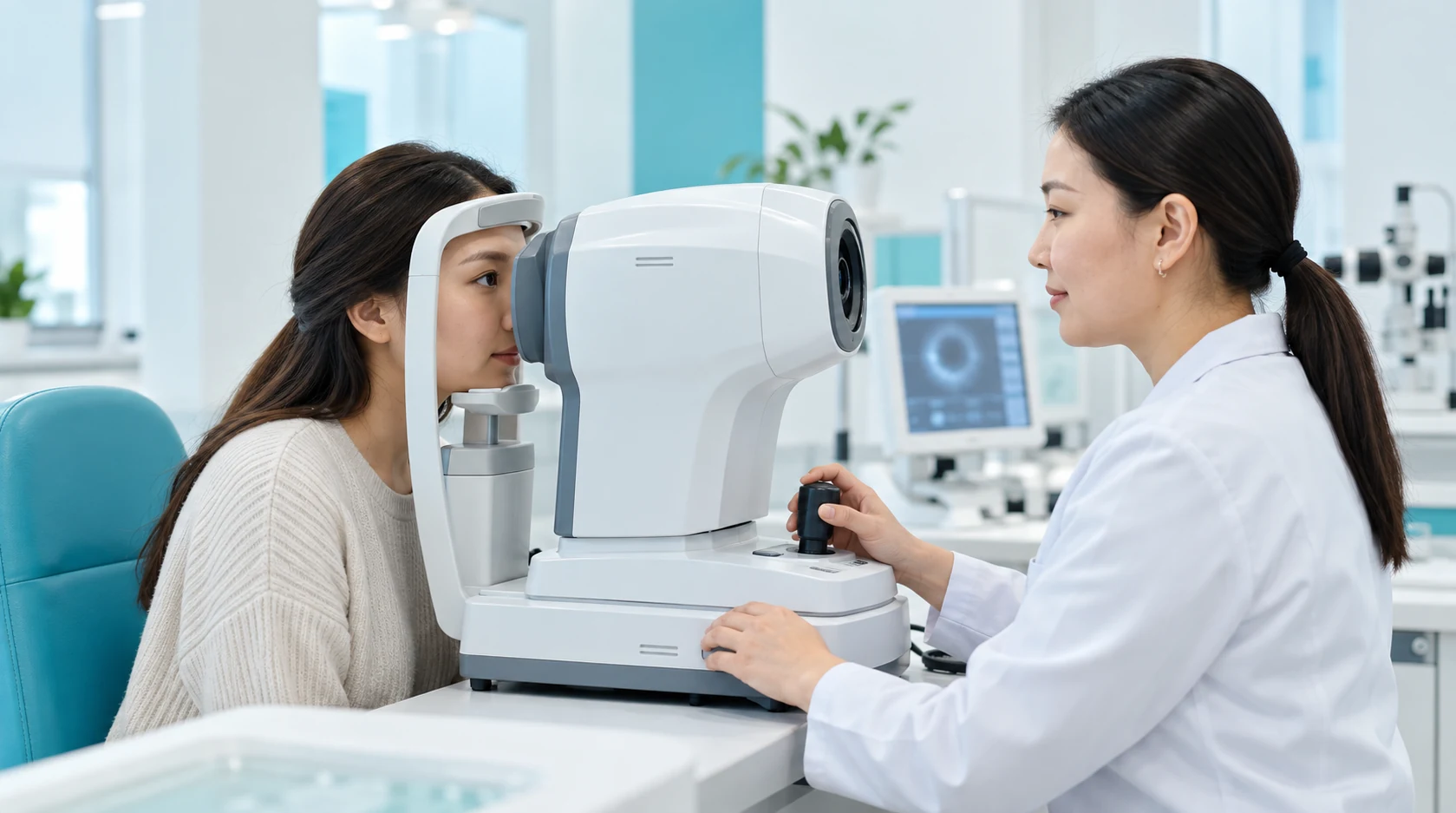
The specialist checks centration and scan or measurement quality and repeats if needed.
Takes: 1 min

The ophthalmologist compares thickness with topography or tomography, pressure, corneal health and other findings to determine management.
Takes: 5 min
Pachymetry measures corneal thickness for use in diagnosis and treatment planning.
Corneal thickness informs the interpretation of tonometry and overall glaucoma risk assessment.
Corneal and refractive measurements help the surgeon assess suitability and plan the selected laser technique.
Comparable repeat measurements help the doctor detect deterioration or stability.
Book an examination if your clinician recommends corneal thickness measurement, you are being assessed for laser vision correction, or pachymetry is needed in glaucoma or corneal disease evaluation. KazRIED will select the appropriate technique and interpret the result within the full eye examination.
The quoted Cirrus-HD price is per eye.
A team of experienced doctors across specialties.

Highest-category ophthalmologist

Highest-category ophthalmologist

Second-category ophthalmologist


Pachymetry measures corneal thickness in the central area or across the entire cornea, depending on the technology used. The examination serves a range of clinical purposes.
Pachymetry does not replace corneal topography or tomography. Pachymetry alone cannot establish a diagnosis of keratoconus.
Contact lenses are removed. Non-contact OCT usually needs no anaesthetic; contact ultrasound requires local anaesthesia.
The result is still interpreted with other tests; a typical thickness does not exclude corneal disease or glaucoma.
Detailed corneal tomography/topography and assessment of other factors may be needed. The thickness value alone does not mean keratoconus.
The doctor assesses possible oedema, endothelial status and other causes using slit-lamp examination and additional tests.
The value is incorporated into surgical planning together with refraction corneal shape and other parameters.
Use the same or comparable device where possible and document device-related differences.
When preparing for laser vision correction, combined assessment of corneal thickness and shape is particularly useful; availability of the specific method must be confirmed.
Kazakhstan’s first specialized ophthalmology institute, operating since 1933.
Modern diagnostics and surgery using world-class equipment.
Leading ophthalmologists in Kazakhstan, scientists and experienced surgeons.
More than 30,000 operations and around 270,000 consultations annually.


Kazakhstan’s first specialized ophthalmology institute, operating since 1933.
Modern diagnostics and surgery using world-class equipment.
Leading ophthalmologists in Kazakhstan, scientists and experienced surgeons.
More than 30,000 operations and around 270,000 consultations annually.
Kazakhstan’s first specialized ophthalmology institute, operating since 1933.
Modern diagnostics and surgery using world-class equipment.
Leading ophthalmologists in Kazakhstan, scientists and experienced surgeons.
More than 30,000 operations and around 270,000 consultations annually.


