
Stable myopia
When refraction is stable and corneal anatomy is suitable.
CLEAR is lenticule-based laser vision correction without a corneal flap. The surgeon removes a laser-created lenticule through a small access incision; suitability is assessed before surgery.
When refraction is stable and corneal anatomy is suitable.
When type and magnitude fall within the platform and surgical protocol range.
The absence of a LASIK flap may matter when mechanical eye trauma is a concern.
When diagnostics confirm medical suitability and expectations are realistic.
When there are no signs of keratoconus, ectasia or suspicious corneal shape.
CLEAR may be considered alongside SMILE based on platform features, astigmatism, centration and surgeon experience.
CLEAR requires comprehensive preoperative refractive diagnostics . The surgeon evaluates refractive error and stability, corneal shape and thickness, topography or tomography, ocular surface, crystalline lens, retina and other parameters. Contact lenses may temporarily alter corneal shape, so the discontinuation period should be confirmed with KazRIED according to lens type.
CLEAR is an elective refractive procedure and does not treat retinal disease, glaucoma, cataract, keratoconus or other causes of reduced vision. Sudden visual loss, severe eye pain, ocular trauma, flashes, a sudden increase in floaters or a curtain-like visual field defect require urgent ophthalmic assessment.
CLEAR is an elective refractive procedure and does not treat retinal disease, glaucoma, cataract, keratoconus or other causes of reduced vision. Sudden visual loss, severe eye pain, ocular trauma, flashes, a sudden increase in floaters or a curtain-like visual field defect require urgent ophthalmic assessment. CLEAR should be selected only after contraindications have been excluded and the planned tissue removal is considered appropriate for the individual cornea.
Book a consultation
Assessment of refraction, cornea, ocular surface, retina and contraindications.
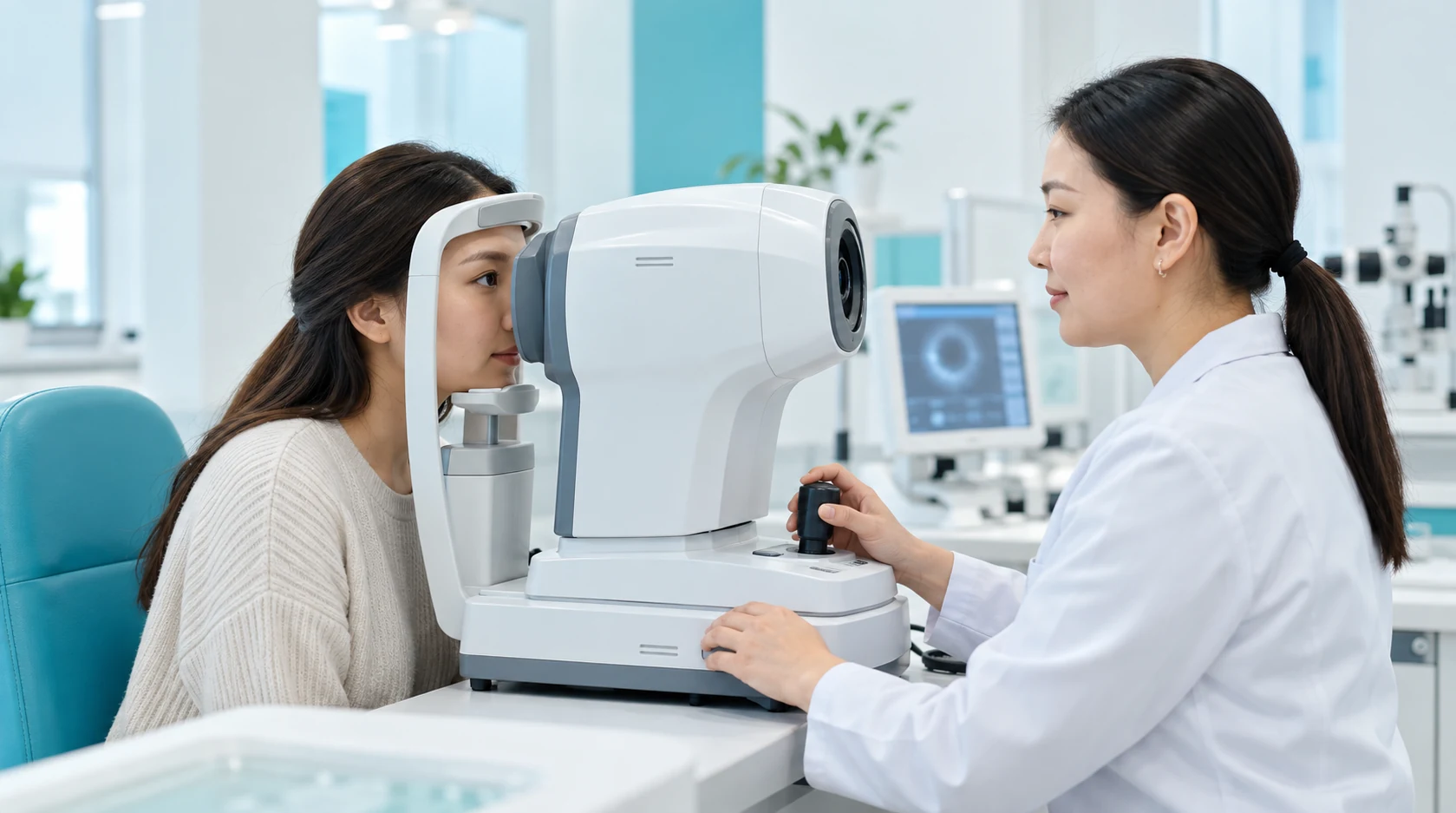
Data checks, topical anaesthesia and surgical-field preparation.
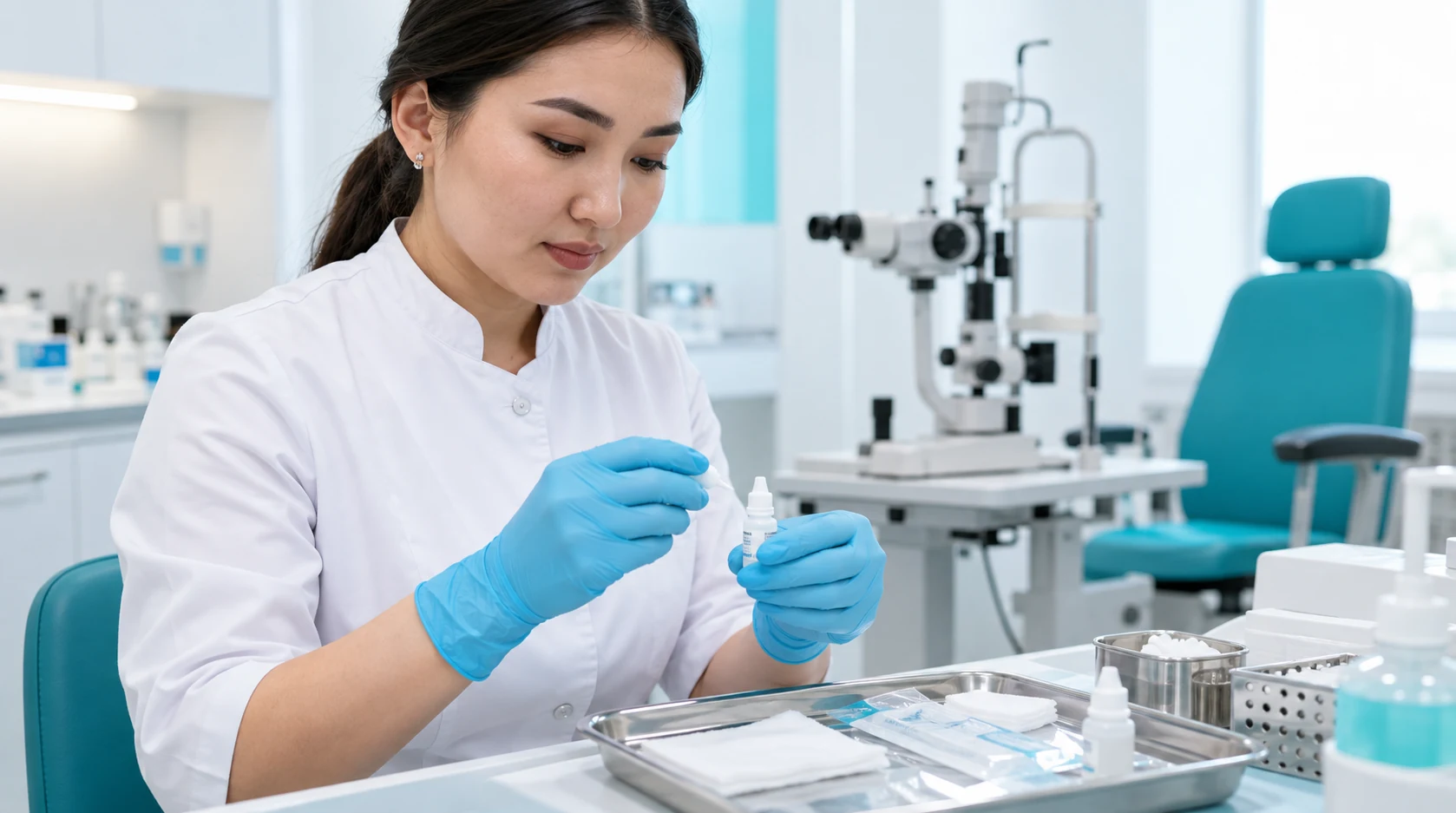
The eye is positioned relative to the laser; the surgeon sets centration parameters.
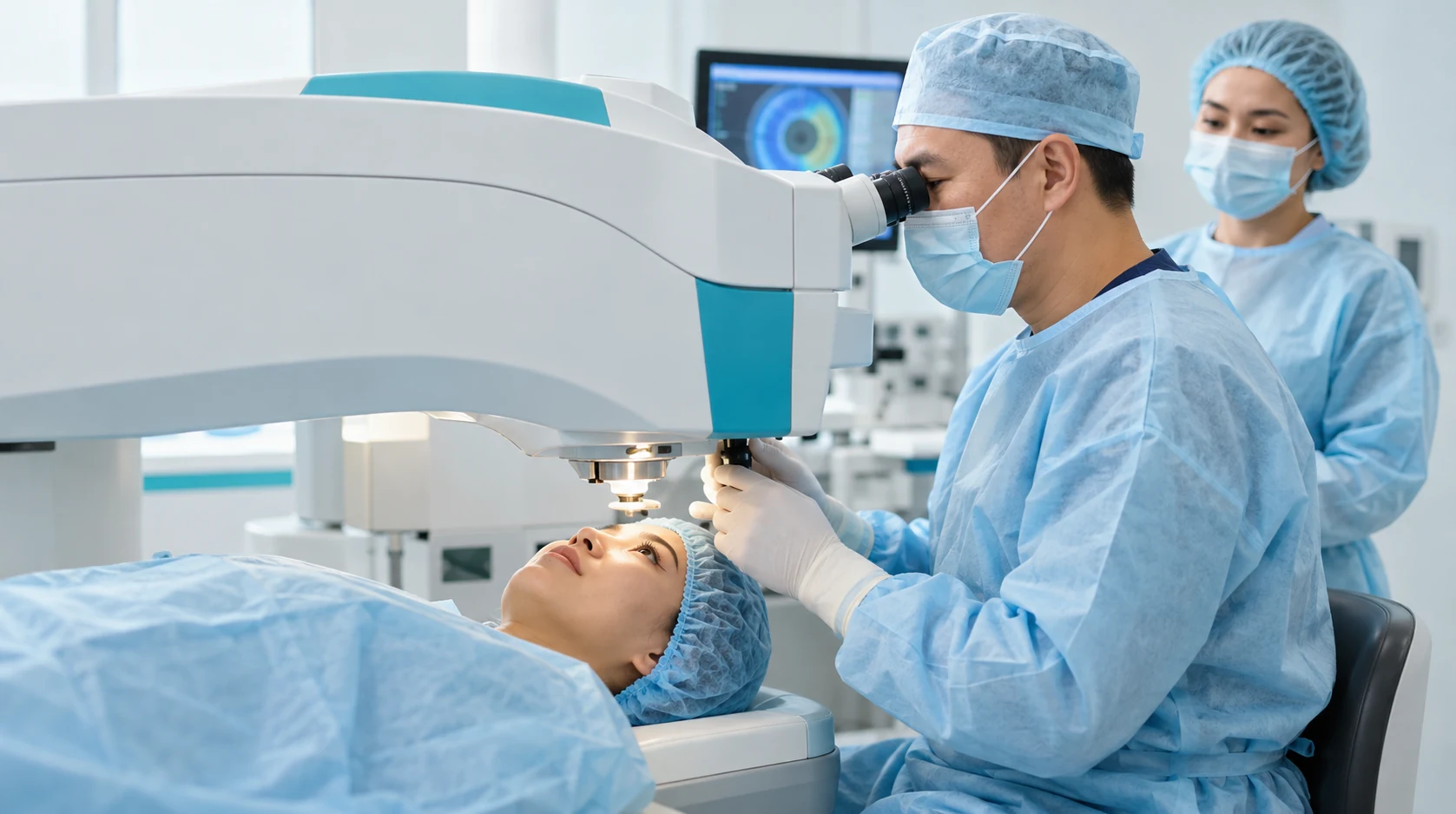
The femtosecond laser creates two lenticule planes and surgical access within the cornea.
The surgeon separates the created planes and removes the lenticule through a small incision.
The cornea is assessed after treatment and at subsequent KazRIED-scheduled visits.

The technique creates no flap, avoiding risks specifically associated with flap displacement.
In lenticule extraction, the lenticule formed inside the cornea is removed through a small incision.
A femtosecond laser creates the lenticule; this technique does not require excimer ablation.
When planning CLEAR, the surgeon considers optical-zone positioning and astigmatism correction requirements.
Book preoperative laser vision correction diagnostics at KazRIED. A refractive surgeon will assess your eyes, explain whether CLEAR is suitable and compare it with ReLEx SMILE, Femto LASIK, TransPRK or another strategy.
A team of experienced doctors across specialties.

Candidate of Medical Sciences; Highest-category ophthalmologist
CLEAR stands for Corneal Lenticule Extraction for Advanced Refractive Correction. It is a form of keratorefractive lenticule extraction.
A femtosecond laser creates a thin optical lenticule within the corneal stroma and a small surgical access incision. After the laser stage, the surgeon separates the lenticule along the laser-created planes and removes it.
Changing the amount of tissue in the central cornea alters its curvature and refractive power.
CLEAR shares its basic principle with ReLEx SMILE, but uses a different laser platform and has its own technological features.
These include centration options, cyclotorsion compensation, and the availability of intraoperative OCT monitoring with the appropriate Ziemer platform configuration.
1. Diagnostics confirm CLEAR suitability – the surgeon finalizes the treatment and follow-up plan.
2. CLEAR is not optimal but ReLEx SMILE may be suitable – another KLEx option is discussed.
3. Lenticule extraction is not optimal but Femto LASIK or surface correction may be suitable – the method changes according to diagnostics.
4. Refraction is unstable – surgery is postponed until stability is confirmed.
5. Ocular surface disease is present – treatment and reassessment come first.
6. Suspicious corneal shape or another ocular disease is found – diagnosis and treatment of the primary condition take priority.
A diagnostic assessment before laser vision correction starts at 28,000 ₸ in Almaty, Astana, and Shymkent. The tests included in the package and payment terms are clarified when booking.
Anti-inflammatory eye drops and an antibiotic are provided after laser vision correction.
Follow-up examinations during the first month are free of charge. Their timing depends on the correction method and recovery progress.
When medically indicated, a laser enhancement procedure within one year is performed free of charge, provided that an examination confirms its feasibility and safety.
The correction method for hyperopia is selected individually after a diagnostic assessment.
Kazakhstan’s first specialized ophthalmology institute, operating since 1933.
Modern diagnostics and surgery using world-class equipment.
Leading ophthalmologists in Kazakhstan, scientists and experienced surgeons.
More than 30,000 operations and around 270,000 consultations annually.


Kazakhstan’s first specialized ophthalmology institute, operating since 1933.
Modern diagnostics and surgery using world-class equipment.
Leading ophthalmologists in Kazakhstan, scientists and experienced surgeons.
More than 30,000 operations and around 270,000 consultations annually.
Kazakhstan’s first specialized ophthalmology institute, operating since 1933.
Modern diagnostics and surgery using world-class equipment.
Leading ophthalmologists in Kazakhstan, scientists and experienced surgeons.
More than 30,000 operations and around 270,000 consultations annually.


