Almaty, Astana Shymkent

Blepharoplasty

from 204.000 ₸
Book an appointment

About the service

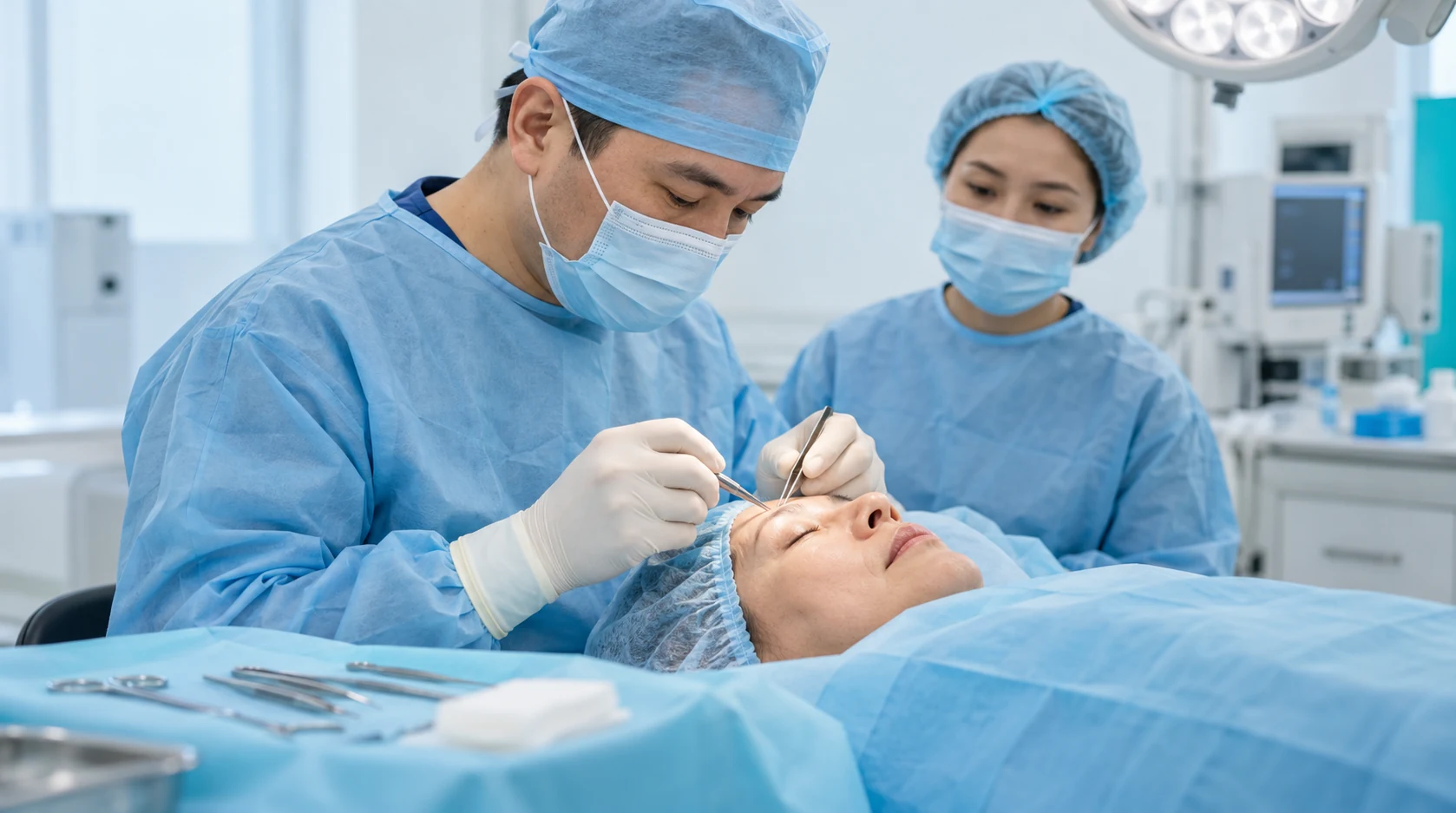
Blepharoplasty corrects excess eyelid skin and, when indicated, adjacent tissues. Before surgery, the surgeon assesses eyelid closure, brow position and the ocular surface as well as appearance.

Who the service is for

Eyelid function and condition

Upper-eyelid skin excess causing marked overhang or a feeling of heaviness. Upper-eyelid fat prominence with preserved eyelid-elevation function. Lower-eyelid skin excess after adequate assessment of lid tone and position.

Visual field

Blepharochalasis that may restrict the superior visual field on examination.

Under-eye tissues

Under-eye bags caused by orbital fat pads when the anatomical cause is confirmed.

Upper eyelid position

If the main concern is a “drooping lid,” ask for separate assessment of true ptosis and brow position because blepharoplasty alone may be insufficient.

Eyelid condition

For lower blepharoplasty, lower-lid laxity, canthal position, and the possible need for support should be assessed.

Limitations and safety

Blepharoplasty should not be planned from a photograph alone.

Book a consultation

Stages

Stage 1

Specialist consultation.

The surgeon clarifies the cosmetic or functional goal, previous procedures, symptoms, and expectations.

Specialist consultation

Service benefits

Addressing excess tissue

When indicated, the surgeon removes or redistributes excess eyelid tissue while considering eyelid function.

A fresher appearance

Correcting age-related eyelid changes and asymmetry can create a more open, rested appearance.

An individual aesthetic result

The extent of correction is planned according to facial anatomy and eyelid health, aiming to preserve natural proportions.

Correction based on the cause

The operation is selected according to skin, muscle, ligament and ocular surface health, rather than appearance alone.

Methods comparison

Criterion
Upper skin approach
Lower skin approach
Lower transconjunctival
Upper + lower
Main target
Upper-lid skin excess and fat when indicated
Lower-lid skin, fat pads, contour
Mainly fat pads without a skin incision
Two zones corrected under separate plans
Skin incision
Yes, usually in the natural crease
Yes, usually just below the lash line
No
Upper incision is present; lower access depends on plan
Marked skin excess
Yes
Yes
Limited, usually not as a stand-alone solution
Yes where indicated
Fat-pad treatment
When indicated
When indicated, removal or repositioning
Primary access target
When indicated in each area
Lower-lid malposition considerations
Not a lower-lid procedure
Requires assessment of laxity and condition of its ligamentous support
Generally less anterior-lamellar disruption, but risk is not zero
Depends on the lower-lid component
Treats true ptosis
Does not replace ptosis repair
No
No
Does not replace ptosis repair
Exact technique publicly confirmed at KazRIED
Upper-lid tariff exists; technique to confirm
Lower-lid tariff exists; technique to confirm
Combined tariff exists; technique to confirm
Upper skin approach
Main target
Skin incision
Marked skin excess
Fat-pad treatment
Lower-lid malposition considerations
Treats true ptosis
Exact technique publicly confirmed at KazRIED
Upper-lid skin excess and fat when indicated
Yes, usually in the natural crease
Yes
When indicated
Not a lower-lid procedure
Does not replace ptosis repair
Upper-lid tariff exists; technique to confirm
Lower-lid skin, fat pads, contour
Yes, usually just below the lash line
Yes
When indicated, removal or repositioning
Requires assessment of laxity and condition of its ligamentous support
No
Lower-lid tariff exists; technique to confirm
Mainly fat pads without a skin incision
No
Limited, usually not as a stand-alone solution
Primary access target
Generally less anterior-lamellar disruption, but risk is not zero
No
Two zones corrected under separate plans
Upper incision is present; lower access depends on plan
Yes where indicated
When indicated in each area
Depends on the lower-lid component
Does not replace ptosis repair
Combined tariff exists; technique to confirm

Book an appointment

The doctor will determine whether the concern is caused by excess skin, fat pads, true ptosis, brow position, or lower-lid anatomy, assess the ocular surface, and define a safe surgical scope.

Book an appointment

Procedure prices

Service name Price
Reconstructive plastic surgery of the upper eyelid (per eye) from 204 000 ₸
Reconstructive plastic surgery of lower eyelid (per eye) from 218 000 ₸
Reconstructive plastic surgery of upper and lower eyelids (per eye) from 315 000 ₸
Reconstructive surgery of the ocular adnexa (per eye) from 238 000 ₸
Repeat reconstructive surgery on the ocular adnexa (per eye) from 256 000 ₸
Our services, payable in installmentsTake care of your vision today and pay for our services in installments. Choose installment terms and a payment schedule that suit you.

Our doctors

A team of experienced doctors across specialties.

All doctorsThe full list of doctors is available here!

Blepharoplasty: technique selection, benefits, and limitations

Blepharoplasty addresses age-related and anatomical changes in eyelid tissues. It does not address all aspects of facial aging.

What is assessed in the upper eyelid?

The surgeon evaluates excess skin, eyelid crease position, fat compartments, the function of the muscle that lifts the eyelid, and brow position.

If a “heavy upper eyelid” results from both excess skin — dermatochalasis — and true ptosis, the role of the eyelid elevator muscle is assessed first. With ptosis or brow descent, skin removal alone may not resolve the concern.

How is the lower eyelid approach selected?

The choice depends on which tissues need correction:

  • With significant excess skin, a transcutaneous approach may be required.
  • With protruding fat compartments and little excess skin, a transconjunctival approach without skin excision may be considered.

Lower eyelid tone and ligament support are also assessed. Excessive tension or tissue removal increases the risk of retraction and ectropion.

If the lower eyelid margin is lax, the plan may include canthal support to strengthen structures at the corner of the eye.

Why is an ophthalmic assessment important?

Dry eye, incomplete eyelid closure, corneal disease, contact lens wear, and previous periocular surgery may affect the extent of surgery and postoperative care.

Modern safety reviews identify ocular surface disease and lower eyelid laxity as important risk factors.

If dryness is present before surgery, the tear film and eyelid closure are assessed first. Surgery may be limited in extent or postponed until the ocular surface is stable.

What changes can be expected?

The aesthetic goal should be specific: reducing skin hooding, correcting fat protrusion, or improving the eyelid contour.

Blepharoplasty does not guarantee perfect symmetry, treat every type of dark circle, automatically remove expression lines, or stop natural aging.

If dark circles are caused by pigmentation or visible blood vessels, surgery may not address the main concern.

Only the planned amount of skin, fat, and other structures is corrected. The technique must preserve complete eyelid closure and a stable lower eyelid position.

When is a reconstructive approach needed?

If asymmetry or eyelid malposition persists after previous blepharoplasty, tissue condition and scarring are assessed before revision surgery is considered.

The general service category “Reconstructive surgery of the ocular adnexa” is not equivalent to aesthetic blepharoplasty.

What should be clear after the consultation?

The consultation should result in a clear anatomical plan. Patients need to understand which tissue causes the concern, what surgery will change, which features will remain, and the individual risks related to their ocular surface and eyelid position.

At KazRIED, aesthetic concerns can be assessed alongside eye function and the condition of its protective structures.

Facts and offers

Kazakhstan’s first specialized ophthalmology institute, operating since 1933.

Modern diagnostics and surgery using world-class equipment.

Leading ophthalmologists in Kazakhstan, scientists and experienced surgeons.

More than 30,000 operations and around 270,000 consultations annually.

Related services

Frequently asked questions

What is blepharoplasty?
Blepharoplasty is surgery of the upper and/or lower eyelids in which excess skin, fat pads and, when necessary, other tissues are adjusted. It may be performed for cosmetic, functional or combined reasons.
How does upper blepharoplasty differ from lower blepharoplasty?
Upper blepharoplasty mainly addresses redundant upper-eyelid skin and, when indicated, fat prominence. Lower blepharoplasty addresses fat pads, under-eye bags, skin excess and other anatomical changes of the lower eyelid.
Who may benefit from upper blepharoplasty?
It may be considered for significant dermatochalasis, skin overhang, fat prominence or redundant tissue that restricts the superior visual field. True eyelid ptosis and brow descent should be assessed separately before surgery.
Does blepharoplasty correct true upper-eyelid ptosis?
Not necessarily. True ptosis results from a problem with the eyelid-elevating mechanism rather than excess skin alone. A separate ptosis procedure may be required depending on the cause and levator function.
Can blepharoplasty reduce under-eye bags?
If the bags are caused by orbital fat prominence and lower-eyelid anatomy, surgery can reduce them. If swelling is related to allergy, systemic disease or another cause of oedema, the underlying cause should be assessed first.

Confirm you are not a robot

Complete the check to send your request.