

Routine Preventive Checkup
If the child has no complaints, the scope and frequency of preventive checkups depend on their age and screening results.
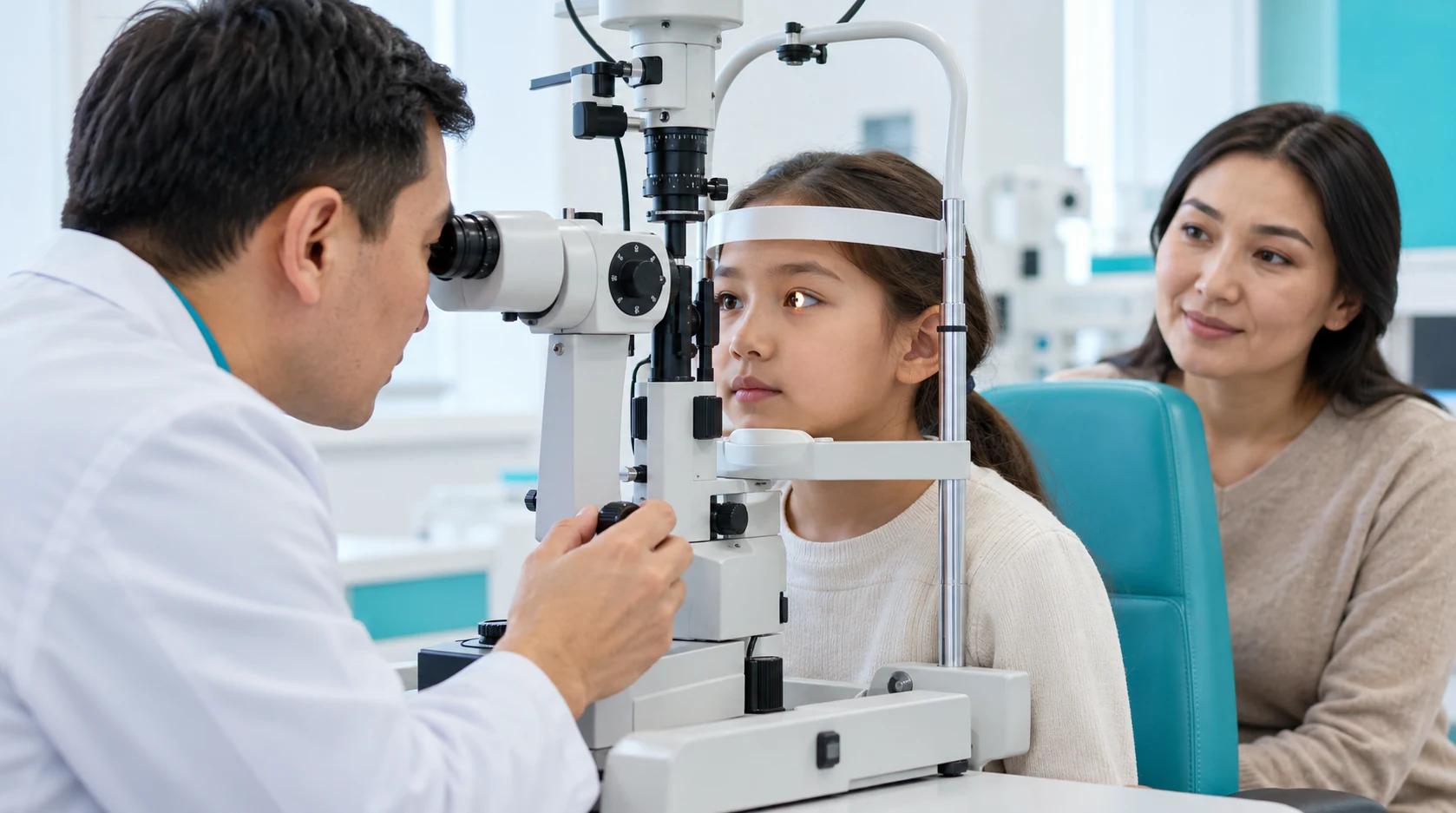
A child’s eye examination takes account of age and visual development. The ophthalmologist assesses visual function, refraction and eye structures, then explains the findings to the parents.
If the child has no complaints, the scope and frequency of preventive checkups depend on their age and screening results.
If the child did not pass a vision test at school, kindergarten, or the pediatrician’s office, a comprehensive examination by an ophthalmologist is required.
It is necessary to monitor refraction, visual acuity in each eye, and the suitability of the current correction.
It is important to track changes in refraction and, when indicated, the axial length of the eye along with other parameters.
An evaluation of eye alignment, binocular functions, visual acuity of each eye, and factors affecting visual development is required.
This may be an attempt to compensate for blurred vision.
This can be a sign of a difference in vision between the eyes or an impairment in how they work together.
Strabismus requires an in-person evaluation by a pediatric ophthalmologist.
It is necessary to assess refraction, accommodation, and binocular vision (how the eyes work together).
Symptoms are non-specific and require an examination, especially if they persist or worsen.
A vision problem is not the only possible cause, but an eye exam helps rule out an ophthalmological factor.
Inform the doctor of the gestational age, birth weight, and retinal monitoring history, if any.
Family history is important for a number of conditions.
Anisometropia can hinder the normal visual development of one eye and increase the risk of amblyopia.
Certain conditions require individualized ophthalmological monitoring.
An evaluation of the eye's condition and dynamics following the injury/procedure is required.
Even if the child rarely wears old glasses, it is useful for the doctor to know their parameters.
Comparing results helps assess changes over time.
Especially important before using diagnostic drops.
If cycloplegia or pupil dilation is needed, it is better to explain in advance that the drops may sting slightly and temporarily blur near vision.
After diagnostic drops, you need to wait for them to take effect, so a full appointment may take longer than a standard chart check.
There is no universal list of absolute contraindications for a routine eye exam.
Before cycloplegia/mydriasis, the doctor considers age, medical history, allergies, and other medical factors.
Perimetry, OCT, and several other tests require gaze fixation and the child's cooperation.
Redness, pain, discharge, or injury are not reasons to cancel medical care, but may require a separate urgent examination rather than a routine check-up.
Requires immediate medical evaluation.
Requires emergency care, not routine planned diagnostics.
Requires prompt in-person evaluation by an ophthalmologist.
Especially if accompanied by worsening vision or general malaise in the child.
Timely medical evaluation is required.
Acute inflammation, eye trauma, sudden vision loss, severe pain or an unusual white reflex from the pupil requires urgent medical assessment rather than a scheduled diagnostic examination.
Book an eye examination
Symptoms, age at onset, glasses, family history and previous examinations.

Age-appropriate assessment of visual acuity, fixation or inter-eye preference.

Evaluation of alignment, motility, pupils and anterior segment; binocular tests when indicated.
Cycloplegia and repeat objective measurement when clinically indicated.
Fundus examination and additional testing according to the clinical question.

Diagnosis or working hypothesis, need for correction, treatment or further tests, and the next review date.
Testing helps identify vision problems the child has not reported or that are difficult to notice at home.
Refraction and visual acuity testing help determine whether glasses or other correction methods are needed.
Assessment of binocular function helps account for both eyes' contribution to vision and identify problems needing treatment.
Repeat measurements allow progress to be assessed and the plan adjusted using objective findings.
Bring the child’s prior reports and current glasses. After the initial examination, the doctor will decide whether cycloplegia, additional instrumental diagnostics or scheduled follow-up is needed.
The price includes intraocular pressure (IOP) measurement and refractometry
Ophthalmologist consultation without diagnostic package
per eye per service per consultation
A team of experienced doctors across specialties.

Candidate of Medical Sciences; Highest-category ophthalmologist

Highest-category ophthalmologist

Highest-category ophthalmologist

Second-category ophthalmologist

Second-category ophthalmologist

Second-category ophthalmologist

Second-category ophthalmologist


Pediatric vision assessment is important not only when a child has complaints. It helps identify refractive errors, anisometropia, amblyopia, strabismus and signs of other eye conditions while the visual system is still developing.
The same diagnostic tests are not necessary for every child. The ophthalmologist considers the child's age, ability to cooperate and perform tests, symptoms, previous examination results, glasses use and family medical history.
In young children, refraction may be assessed using retinoscopy, while school-aged children may also undergo autorefraction and subjective refraction assessment. If latent hyperopia, accommodative spasm or inaccurate measurements are suspected, the ophthalmologist may recommend cycloplegia.
Children have strong accommodative ability, which can affect the accuracy of standard refraction measurements. Cycloplegia temporarily relaxes accommodation using special eye drops and, in certain clinical situations, allows more accurate assessment of hyperopia, myopia, astigmatism and refractive differences between the eyes.
A child's vision cannot be assessed solely by their ability to read letters on an eye chart. Objective and age-appropriate methods are used for infants and preschool children, so an inability to read an eye chart does not prevent examination.
The ophthalmologist evaluates visual fixation and tracking, eye alignment, pupillary responses and the red reflex. Refraction is assessed using retinoscopy or instrument-based methods.
If strabismus or amblyopia is suspected, the examination includes not only the visual function of each eye separately but also how the two eyes work together.
Accurate refraction assessment and monitoring changes over time are particularly important during childhood. Uncorrected differences in refraction between the two eyes may contribute to the development of amblyopia.
For children with myopia, previous glasses prescriptions and ophthalmology reports help assess the rate of progression. Current diopter measurements alone are insufficient to determine how myopia is changing. The ophthalmologist may recommend additional measurements and follow-up visits.
Vision screening and comprehensive ophthalmological assessment serve different purposes. Screening quickly identifies children at increased risk of vision problems. A comprehensive medical eye examination is required when a child does not pass screening, has symptoms or presents with risk factors.
The pediatric ophthalmologist determines the scope of the examination. Basic tests may be supplemented by cycloplegia, binocular vision assessment, fundus examination, ocular biometry, optical coherence tomography (OCT), ultrasound or other investigations only when clinically indicated.
Kazakhstan’s first specialized ophthalmology institute, operating since 1933.
Modern diagnostics and surgery using world-class equipment.
Leading ophthalmologists in Kazakhstan, scientists and experienced surgeons.
More than 30,000 operations and around 270,000 consultations annually.


Kazakhstan’s first specialized ophthalmology institute, operating since 1933.
Modern diagnostics and surgery using world-class equipment.
Leading ophthalmologists in Kazakhstan, scientists and experienced surgeons.
More than 30,000 operations and around 270,000 consultations annually.
Kazakhstan’s first specialized ophthalmology institute, operating since 1933.
Modern diagnostics and surgery using world-class equipment.
Leading ophthalmologists in Kazakhstan, scientists and experienced surgeons.
More than 30,000 operations and around 270,000 consultations annually.


