

Femto LASIK
Femto LASIK combines femtosecond laser flap creation with excimer laser corneal reshaping.
Learn moreFemto LASIK combines femtosecond laser flap creation with excimer laser corneal reshaping.
Learn moreReLEx SMILE corrects vision by removing a laser-created corneal lenticule through a small incision.
Learn moreCLEAR is lenticule-based laser vision correction without a corneal flap.
Learn moreTransPRK is surface laser vision correction without a corneal flap.
Learn moreMyopia correction helps improve distance vision. Glasses, contact lenses and surgical options are selected after assessment; progressing myopia also requires a separate control strategy.
Adults with stable myopia who want to reduce dependence on glasses or contact lenses and compare surgical options.
Patients with myopia and astigmatism when diagnostics confirm suitability for a selected correction method.
People with high myopia who need not only optical correction but also retinal assessment, axial-length evaluation and consideration of a phakic IOL.
Patients with a relatively thin but structurally normal cornea in whom surface correction may be considered after tomography instead of flap-based methods.
Patients whose glasses or contact lenses interfere with work, sport or daily activities and who want to discuss alternatives.
Children and adolescents with myopia – for accurate optical correction and a separate assessment of progression. Laser refractive surgery is not the standard pathway for this group.
Patients with changing refraction or borderline parameters – for observation and repeat assessment before a surgical decision.
Myopia correction does not make the eye anatomically non-myopic. Laser surgery or lens implantation does not shorten the axial length of the eye, so high myopia still requires retinal monitoring. Refractive surgery does not guarantee perfect unaided vision and does not exclude dryness, glare, halos, residual refractive error, infection or other rare complications.
Selecting correction requires more than the number of dioptres. The doctor assesses age, refractive stability, best-corrected visual acuity, corneal shape and thickness, ocular surface, crystalline lens and retina. Peripheral retinal examination is particularly important in high myopia because optical or refractive correction improves focusing but does not eliminate the anatomical risks of an elongated eye.
Laser refractive surgery is usually not considered for children and adolescents until eye growth is complete and refraction has stabilised.
Seek urgent ophthalmic assessment for sudden flashes, a rapid increase in floaters, a curtain-like field defect, sudden visual loss, severe pain, marked redness or eye trauma. Flashes of light, a sudden shower of floaters, a curtain-like field defect, sudden visual loss, severe pain or marked redness require prompt ophthalmic assessment.
Myopia correction does not make the eye anatomically non-myopic.
Book a consultation
Correcting current blurred distance vision or also assessing myopia progression risk.

Visual acuity, refraction, anterior-segment assessment, pressure and other indicated tests.
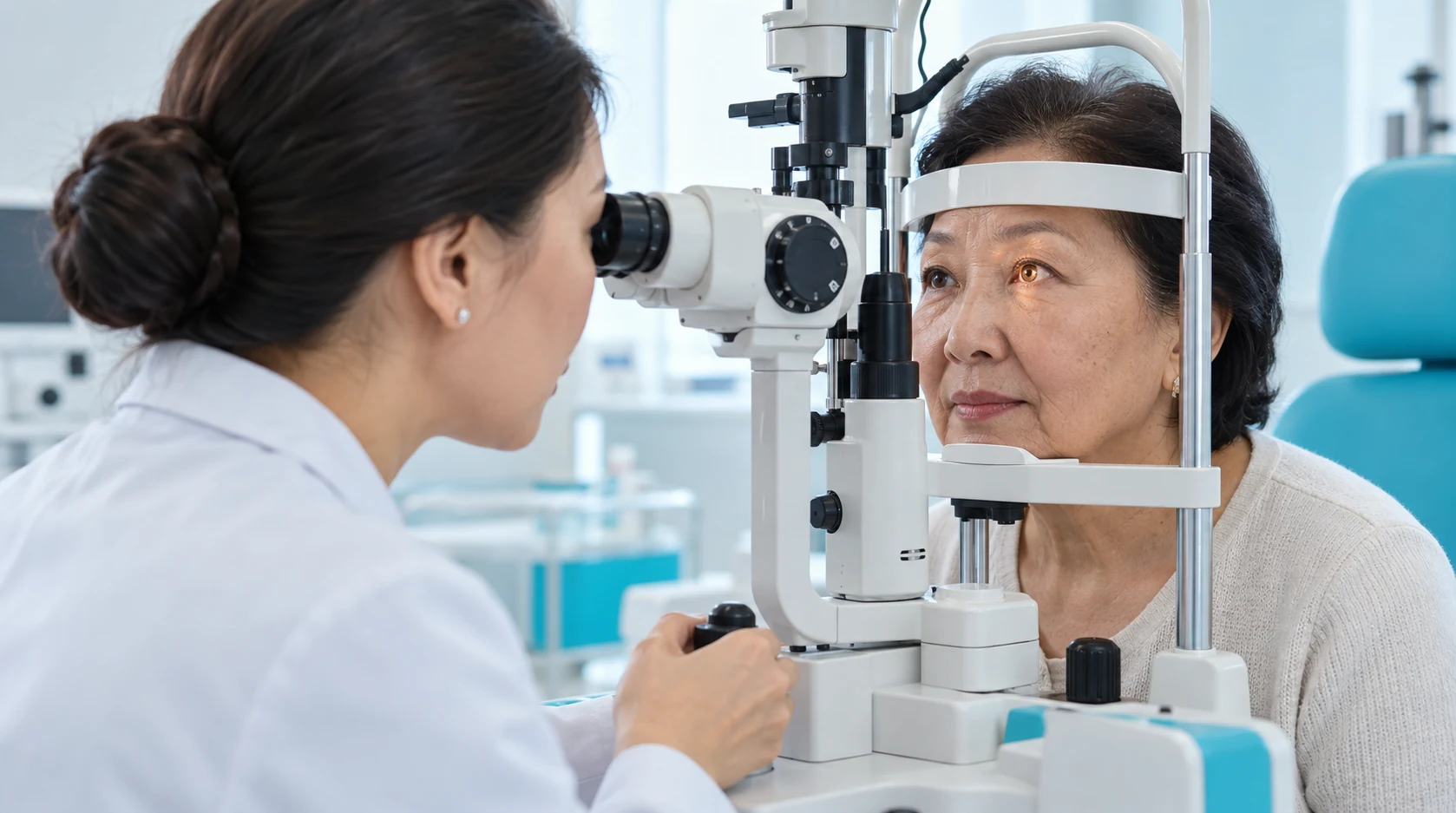
Before surgery, the surgeon assesses corneal thickness and shape and, in myopia, the retina.
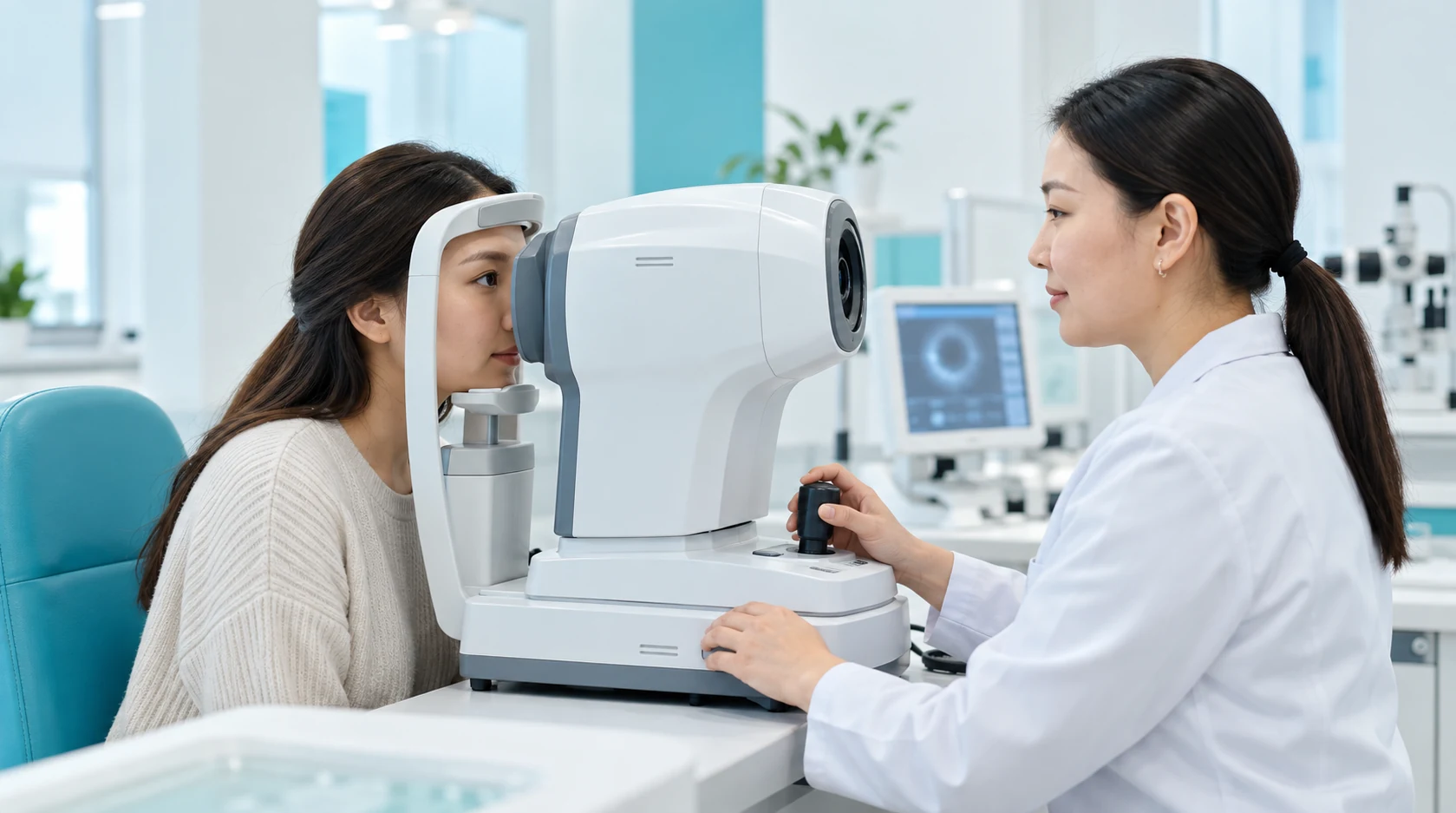
Glasses, contact lenses, orthokeratology, laser methods or phakic IOLs, considering age, refractive stability and eye anatomy.

If surgery is selected, the patient receives individual instructions on lenses, medicines, tests and procedure day.

The selected method is performed.
The doctor assesses the cornea, visual quality, ocular surface and adherence.

Age-related and myopia-related risks remain after refractive correction.
Appropriate myopia correction helps focus images on the retina and improve distance vision.
The doctor compares visual needs, eye measurements and limitations of different correction options.
Comparing glasses, contact lenses and surgical options helps identify a suitable solution according to clinical indications.
Glasses, contact lenses and surgery are discussed as distinct options according to clinical indications.
Book a KazRIED diagnostic assessment to determine not only the degree of myopia but the most appropriate correction pathway. The clinician will compare optical and surgical options, evaluate the cornea and retina, and explain which method fits your ocular parameters and visual goals.
A team of experienced doctors across specialties.

Candidate of Medical Sciences; Highest-category ophthalmologist

Candidate of Medical Sciences; Highest-category ophthalmologist

Candidate of Medical Sciences; Highest-category ophthalmologist

Highest-category ophthalmologist

Highest-category ophthalmologist

Highest-category ophthalmologist
Highest-category ophthalmologist

Highest-category ophthalmologist

Highest-category ophthalmologist

Highest-category ophthalmologist
The key question when choosing TransPRK is whether surface correction is suitable for the individual patient’s cornea and lifestyle.
TransPRK eliminates a separate mechanical step for removing the epithelium, but healing remains characteristic of surface ablation.
Patients should therefore understand the difference between the duration of the procedure itself and the time needed for functional visual recovery.
The term “no-touch” refers to the way the corneal surface is treated with the laser, not to the absence of a healing process.
After TransPRK, the epithelium must regenerate. This process determines the course of the first few days of recovery.
Correcting current blurred distance vision or also assessing myopia progression risk: these are different clinical goals.
Before surgical correction, the surgeon assesses corneal thickness and shape and, in myopia, the retina. Prophylactic laser coagulation is not compulsory and is used when indicated.
The selected method is performed. Technique, anaesthesia, duration and postoperative prescriptions depend on the procedure.
Age-related and myopia-related risks remain after refractive correction. In high myopia, retinal monitoring remains important even with good unaided vision.
When correcting myopia, it is important to choose a method suited to the individual eye.
Low and moderate myopia can be effectively corrected in several ways. High myopia, a thin cornea, significant dry eye, or changes in the crystalline lens or retina may substantially affect the choice.
The appropriate pathway therefore begins with a diagnostic assessment rather than a technology selected in advance.
Myopia correction addresses how to make the image clear, while myopia control addresses how to try to slow further progression.
For an adult with stable refraction, selecting a surgical method may become a primary consideration.
For a child or teenager, accurate correction and assessment of progression remain the priorities.
Kazakhstan’s first specialized ophthalmology institute, operating since 1933.
Modern diagnostics and surgery using world-class equipment.
Leading ophthalmologists in Kazakhstan, scientists and experienced surgeons.
More than 30,000 operations and around 270,000 consultations annually.


Kazakhstan’s first specialized ophthalmology institute, operating since 1933.
Modern diagnostics and surgery using world-class equipment.
Leading ophthalmologists in Kazakhstan, scientists and experienced surgeons.
More than 30,000 operations and around 270,000 consultations annually.
Kazakhstan’s first specialized ophthalmology institute, operating since 1933.
Modern diagnostics and surgery using world-class equipment.
Leading ophthalmologists in Kazakhstan, scientists and experienced surgeons.
More than 30,000 operations and around 270,000 consultations annually.


