

Stable myopia
For patients with stable refraction when corneal and ocular parameters meet procedural criteria.
ReLEx SMILE corrects vision by removing a laser-created corneal lenticule through a small incision. No corneal flap is created; suitability is determined after diagnostic assessment.
For patients with stable refraction when corneal and ocular parameters meet procedural criteria.
For myopia combined with regular astigmatism within the platform-specific treatment range.
The absence of a LASIK flap may be relevant when mechanical eye trauma is a concern.
For patients seeking less dependence on optical correction and who are medically suitable.
Only when topography/tomography shows no ectatic pattern or other contraindication.
May be considered after ocular surface assessment and treatment; dry eye remains possible.
Before surgery, patients need a dedicated laser vision correction work-up. It assesses more than refractive error: corneal shape and thickness, refractive stability, ocular surface, crystalline lens and retina are evaluated. Contact lenses can temporarily alter corneal measurements, so the required discontinuation period should be confirmed with KazRIED.
Sudden vision loss, significant eye pain, ocular trauma, flashes, a sudden increase in floaters or a curtain-like visual field defect require urgent ophthalmic assessment and should not wait for elective refractive surgery.
ReLEx SMILE does not treat retinal disease, glaucoma, cataract, keratoconus or other causes of reduced vision.
It changes corneal optical power and does not replace routine eye care.
Sudden vision loss, significant eye pain, ocular trauma, flashes, a sudden increase in floaters or a curtain-like visual field defect require urgent ophthalmic assessment and should not wait for elective refractive surgery. ReLEx SMILE does not treat retinal disease, glaucoma, cataract, keratoconus or other causes of reduced vision. It changes corneal optical power and does not replace routine eye care.
Book a consultation
Confirmation of refractive stability and corneal safety.
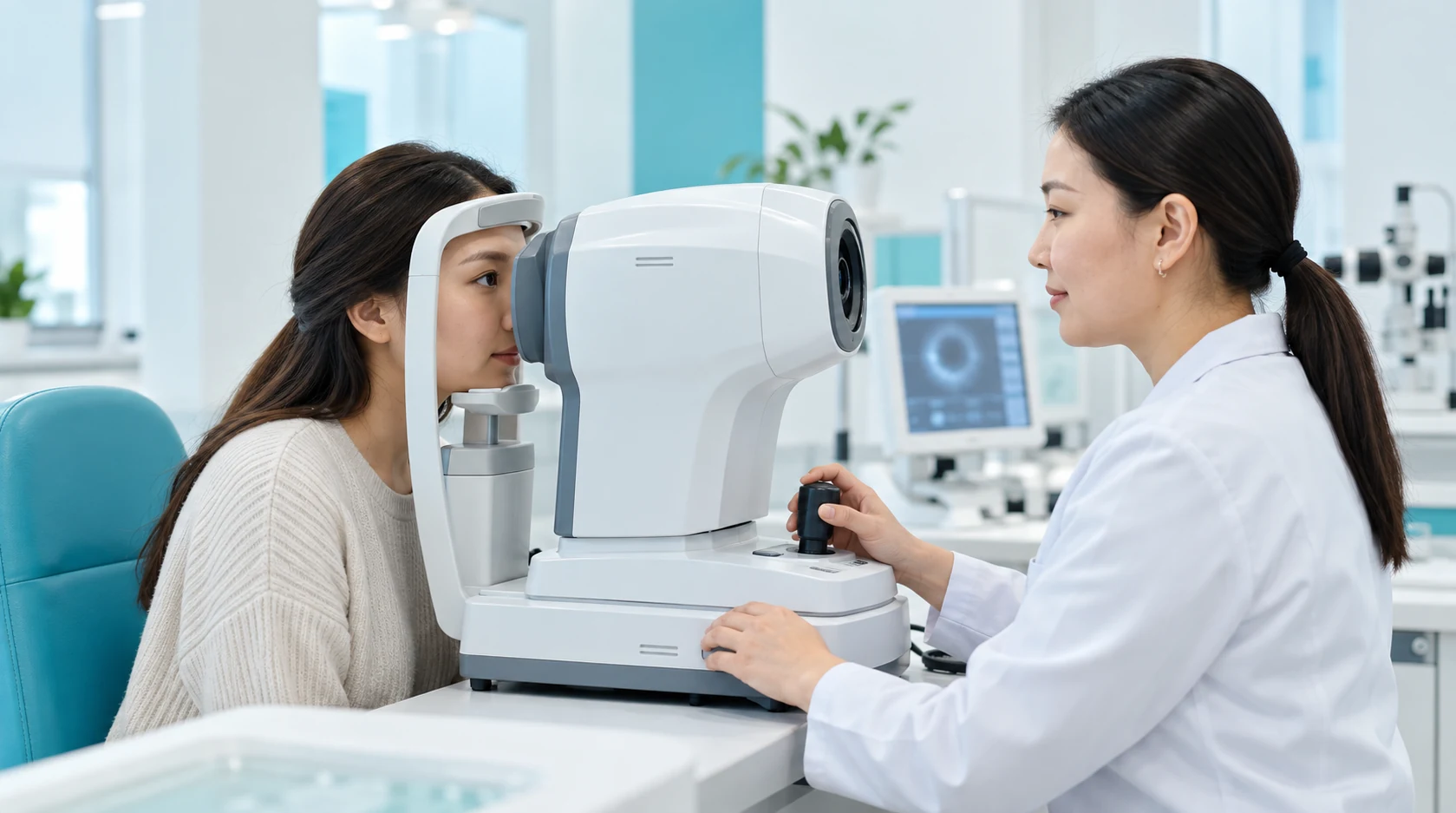
Data checks, topical anaesthesia and surgical-field preparation.

The laser creates a lenticule and small access incision within the cornea.
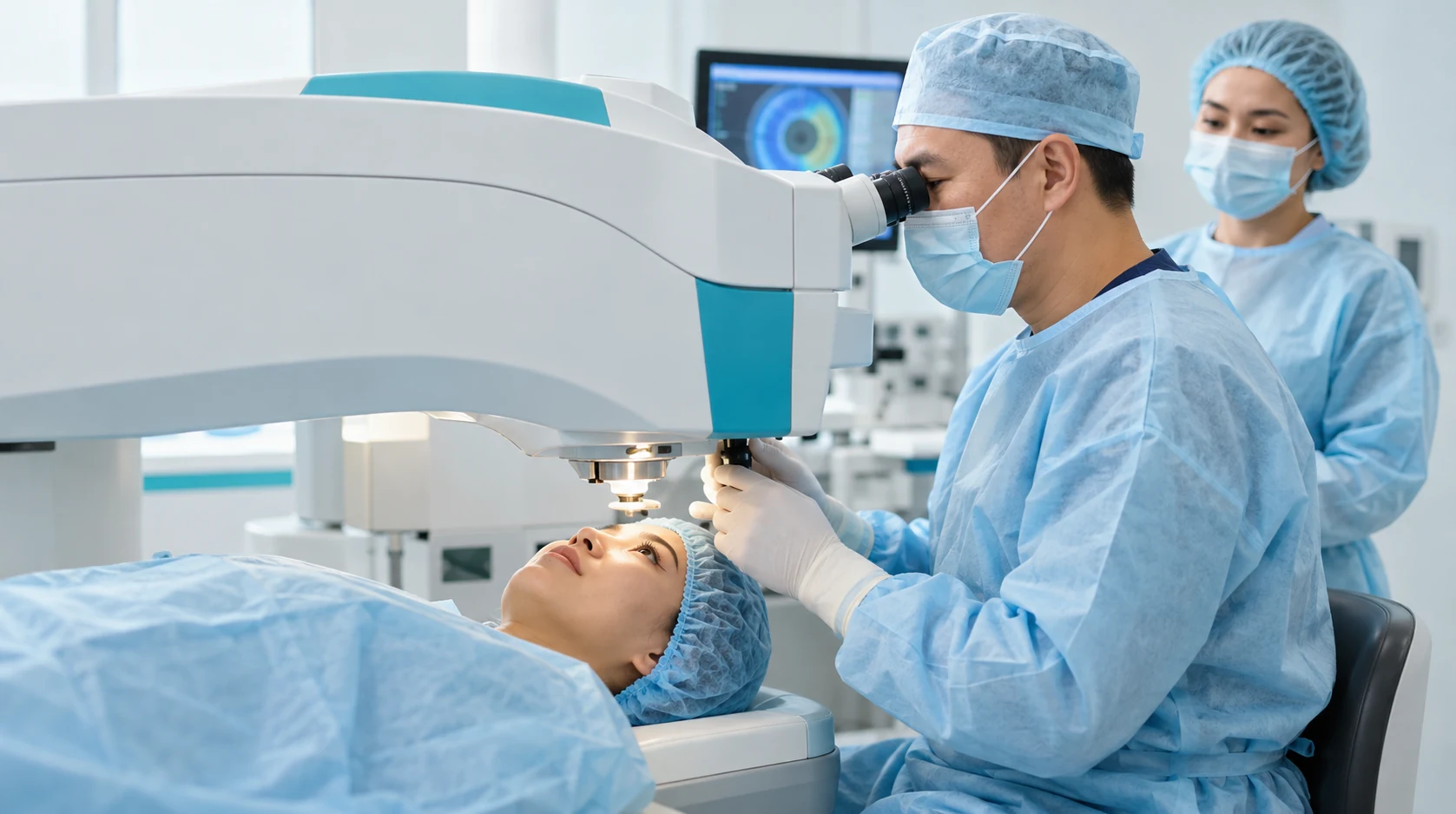
The surgeon separates the created tissue planes and removes the lenticule through the incision.
Assessment of the eye and individual advice.

Monitoring recovery and refractive outcome according to KazRIED's schedule.
The technique creates no flap, avoiding risks specifically associated with flap displacement.
In lenticule extraction, the lenticule formed inside the cornea is removed through a small incision.
A femtosecond laser creates the lenticule; this technique does not require excimer ablation.
Laser correction can reduce the need for glasses or contact lenses when clinically appropriate.
Book a preoperative laser vision correction assessment at KazRIED. After testing, a refractive surgeon will explain whether ReLEx SMILE is suitable for your eyes, compare alternatives and recommend an appropriate treatment strategy.
A team of experienced doctors across specialties.

Candidate of Medical Sciences; Highest-category ophthalmologist
Highest-category ophthalmologist

First-category ophthalmologist

ReLEx SMILE belongs to keratorefractive lenticule extraction procedures. A femtosecond laser creates a thin refractive lenticule within the corneal stroma according to the planned correction. The surgeon separates and removes the lenticule through a small peripheral incision, changing corneal curvature and optical power. Unlike LASIK and Femto LASIK, no corneal flap is created.
Unlike PRK and TransPRK, a large central epithelial area is not removed. SMILE is not universally superior: suitability depends on refraction, corneal topography and tomography, tissue thickness, ocular surface, age, lifestyle and other clinical factors.
1. Diagnostics confirm SMILE suitability – the surgeon finalizes the surgical and follow-up plan.
2. SMILE is not optimal but another method may be suitable – Femto LASIK, CLEAR, PRK/TransPRK or another option is discussed.
3. Refraction is unstable – surgery is postponed until stability is confirmed.
4. Ocular surface disease is present – treatment and repeat assessment come first.
5. Suspicious corneal findings are detected – refractive surgery is deferred pending further evaluation.
6. Retinal, lens or other ocular disease is found – the primary condition takes priority.
Kazakhstan’s first specialized ophthalmology institute, operating since 1933.
Modern diagnostics and surgery using world-class equipment.
Leading ophthalmologists in Kazakhstan, scientists and experienced surgeons.
More than 30,000 operations and around 270,000 consultations annually.


Kazakhstan’s first specialized ophthalmology institute, operating since 1933.
Modern diagnostics and surgery using world-class equipment.
Leading ophthalmologists in Kazakhstan, scientists and experienced surgeons.
More than 30,000 operations and around 270,000 consultations annually.
Kazakhstan’s first specialized ophthalmology institute, operating since 1933.
Modern diagnostics and surgery using world-class equipment.
Leading ophthalmologists in Kazakhstan, scientists and experienced surgeons.
More than 30,000 operations and around 270,000 consultations annually.


