
Eyelid function and condition
Patients with involutional entropion when the lower eyelid margin repeatedly turns inward and irritates the eye.
Entropion or ectropion correction restores a more appropriate eyelid position and helps protect the ocular surface. Surgery is selected according to the cause, tissue condition and eyelid closure.
Patients with involutional entropion when the lower eyelid margin repeatedly turns inward and irritates the eye.
Patients with involutional ectropion when the lower eyelid pulls away from the globe and causes tearing, dryness or chronic irritation.
Patients with cicatricial malposition after trauma, burns, inflammation or previous eyelid surgery.
Patients with paralytic ectropion due to facial nerve palsy when eyelid apposition and corneal protection are impaired.
Patients with recurrent entropion or ectropion after prior treatment who need reassessment of the reason for recurrence.
Do not try to turn the eyelid out manually, remove lashes, cauterize the eyelid margin or use antibiotic or steroid eye drops without medical advice.
Children and adults with congenital eyelid malposition after specialist ophthalmic evaluation.
Active eyelid, conjunctival or skin inflammation may need treatment before elective surgery. In facial nerve palsy, the doctor evaluates not only eyelid position but also complete eye closure and the risk of exposure keratopathy.
Perfect symmetry, absence of recurrence and the same recovery time for every patient cannot be guaranteed.
After surgery, swelling, bruising, temporary discomfort, dryness or tearing may occur.
Less common risks include bleeding, infection, scarring, undercorrection, overcorrection, asymmetry, recurrence and the need for revision.
Bring previous reports, discharge summaries after surgery , information about eyelid trauma or burns, and older photographs if they show the eyelid before the deformity developed.
Tell the doctor about facial nerve palsy, skin or connective tissue disease, chronic blepharitis , previous blepharoplasty and other eyelid procedures.
Severe pain, photophobia, sudden visual loss, a white or cloudy corneal spot, or inability to close the eye completely requires urgent ophthalmic assessment. If the eyelid malposition developed together with sudden facial weakness, speech disturbance or other neurologic symptoms, urgent evaluation of the cause is required.
Significant pain, photophobia, rapid visual deterioration, a corneal defect or clouding requires urgent assessment because chronic rubbing or exposure can damage the cornea.
Significant pain, photophobia, rapid visual deterioration, a corneal defect or clouding requires urgent assessment because chronic rubbing or exposure can damage the cornea.
Book a consultation
The doctor reviews onset and any injuries, burns, surgery, skin or facial nerve conditions or chronic inflammation.

Visual acuity, lid margins, lashes, puncta, closure, brow position and ocular surface are assessed.

The surgeon assesses horizontal lid laxity, retractors, scarring and other signs defining the mechanism of entropion or ectropion.
Lubricants and other temporary measures are prescribed when needed.

The technique depends on the cause.
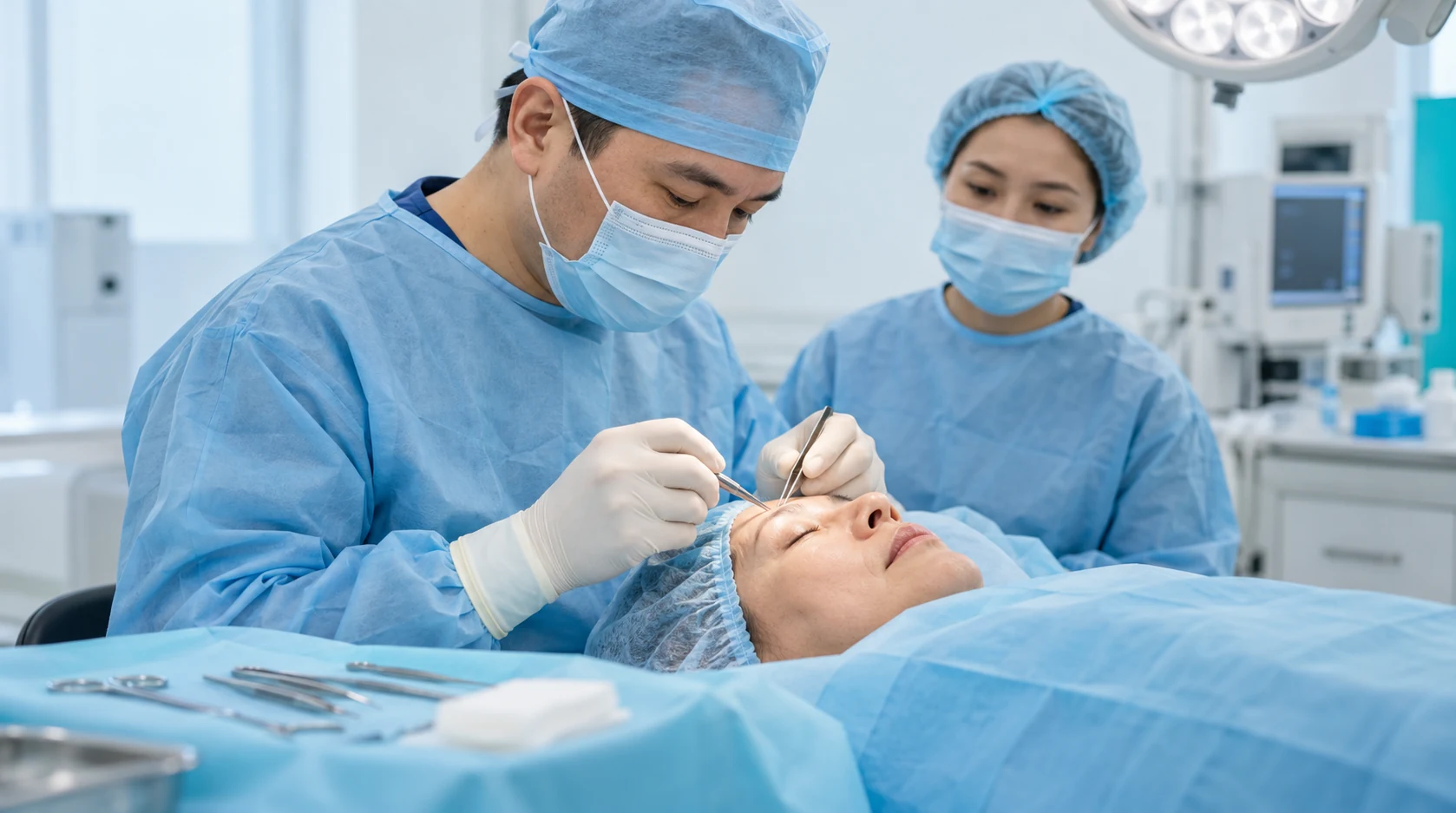
The doctor monitors lid position, closure, sutures and cornea.

Correction of entropion or ectropion helps restore a more appropriate eyelid margin position against the eye.
Treatment aims to reduce corneal irritation and restore eyelid protection according to the cause of the problem.
Correct eyelid position supports tear distribution and drainage when these have been affected by eyelid deformity.
The operation is selected according to skin, muscle, ligament and ocular surface health, rather than appearance alone.
The doctor will determine whether the problem is entropion, ectropion, trichiasis or another eyelid malposition, assess the cornea and develop a treatment plan. Severe pain, sudden visual loss or inability to close the eye completely requires prompt medical assessment rather than waiting for a routine appointment.
A team of experienced doctors across specialties.

Highest-category ophthalmologist

First-category ophthalmologist

Second-category ophthalmologist


The eyelid protects the eye, distributes the tear film, and normally rests closely against the eyeball. Abnormal eyelid position can damage the ocular surface and interfere with tear drainage.
In entropion, the eyelid margin turns inward. The eyelashes rub against the conjunctiva and cornea, causing a foreign body sensation, tearing, redness, and erosions. Prolonged contact can cause more serious corneal damage.
In ectropion, the eyelid margin turns outward. The conjunctiva remains exposed, and the lacrimal punctum may lose contact with the tear lake.
Tearing and dryness can therefore occur together: tears are produced but are not distributed or drained properly.
The clinician checks eyelid margin and eyelash position, horizontal and vertical stability, orbicularis muscle function, punctal position, and completeness of eyelid closure.
Slit-lamp examination assesses the anterior segment and ocular surface, including corneal epithelial damage. Visual acuity testing measures the level of vision.
Surgery is planned to correct the specific anatomical mechanism causing the deformity.
Lubricants, a protective contact lens, temporary eyelid taping, or other measures may be prescribed when needed.
These can relieve irritation and protect the cornea but do not always resolve the anatomical cause. If the eyelashes continue to rub against the cornea or the eye remains open, the clinician assesses the need for surgical correction.
The choice depends on the cause, tissue condition, punctal position, horizontal and vertical eyelid laxity, and corneal condition.
Treatment may involve eyelid tightening and shortening, retractor repair, canthal correction, or tissue reconstruction.
Upper eyelid reconstructive surgery is performed for specific indications established during examination.
Trichiasis treatment without eyelid reconstruction does not replace entropion correction when eyelash contact is caused by abnormal eyelid position.
The clinician monitors eyelid position, closure, sutures, and corneal condition. Follow-up timing and restrictions are determined individually.
The outcome is assessed by proper eyelid apposition, complete closure, absence of eyelash contact with the cornea, and normal punctal position.
Contact the clinician without waiting for a scheduled visit if increasing pain, a sudden reduction in vision, marked redness, or purulent discharge occurs after surgery.
Kazakhstan’s first specialized ophthalmology institute, operating since 1933.
Modern diagnostics and surgery using world-class equipment.
Leading ophthalmologists in Kazakhstan, scientists and experienced surgeons.
More than 30,000 operations and around 270,000 consultations annually.


Kazakhstan’s first specialized ophthalmology institute, operating since 1933.
Modern diagnostics and surgery using world-class equipment.
Leading ophthalmologists in Kazakhstan, scientists and experienced surgeons.
More than 30,000 operations and around 270,000 consultations annually.
Kazakhstan’s first specialized ophthalmology institute, operating since 1933.
Modern diagnostics and surgery using world-class equipment.
Leading ophthalmologists in Kazakhstan, scientists and experienced surgeons.
More than 30,000 operations and around 270,000 consultations annually.


