
Femto LASIK
Femto LASIK combines femtosecond laser flap creation with excimer laser corneal reshaping.
Learn moreFemto LASIK combines femtosecond laser flap creation with excimer laser corneal reshaping.
Learn moreReLEx SMILE corrects vision by removing a laser-created corneal lenticule through a small incision.
Learn moreCLEAR is lenticule-based laser vision correction without a corneal flap.
Learn moreVisian ICL Toric is a phakic toric lens that corrects refractive error and astigmatism while preserving the natural lens.
Learn moreAstigmatism correction addresses blurred vision caused by differing optical power across the eye’s meridians. Glasses, lenses or surgery are selected according to the source of astigmatism and eye health.
Adults with stable regular astigmatism who need accurate optical correction. Patients with myopic astigmatism considering laser vision correction after corneal assessment. Patients with hyperopic or mixed astigmatism if parameters are suitable for Femto-LASIK or another confirmed method. People who prefer toric contact lenses to spectacles.
Patients with high ametropia and astigmatism who need assessment for a toric phakic IOL.
Patients with cataract and corneal astigmatism who may benefit from a toric IOL.
Children with astigmatism, for optical correction, amblyopia prevention and follow-up; surgery is considered only for special indications.
Astigmatism is not always a simple stable refractive error. Irregular astigmatism, rapid cylinder change, corneal asymmetry or suspected keratoconus require separate evaluation and may exclude standard laser vision correction. Cross-linking is intended to stabilize progressive ectasia, not to serve as routine cylinder removal. Refractive surgery should not be marketed as standard treatment for children.
Before correction, more than the cylinder and axis must be established. The doctor assesses whether astigmatism is regular or irregular, predominantly corneal or lenticular, and associated with myopia or hyperopia. Surgical planning requires corneal topography or tomography, pachymetry, refractive stability, and assessment of the ocular surface and crystalline lens.
In cataract, the toric IOL and its axis are calculated separately.
Urgent ophthalmic assessment is required for sudden distortion or loss of vision, pain, marked redness, trauma, flashes or a curtain-like visual defect.
Astigmatism is not always a simple stable refractive error.
Book a consultation
Distance, near, driving, screens, sport and tolerance of glasses and lenses.

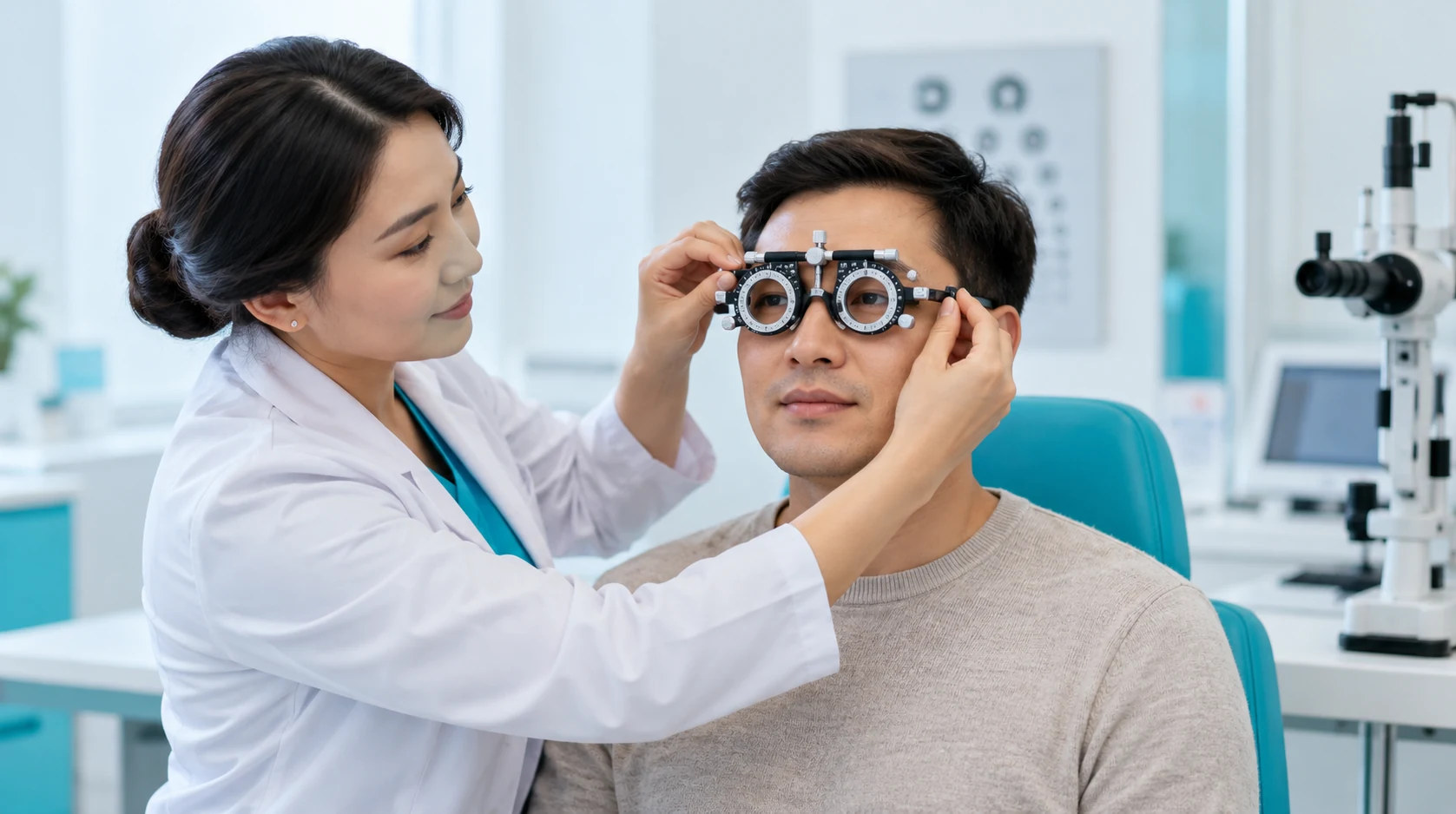
Sphere, cylinder and axis measurement with best-corrected visual acuity testing.
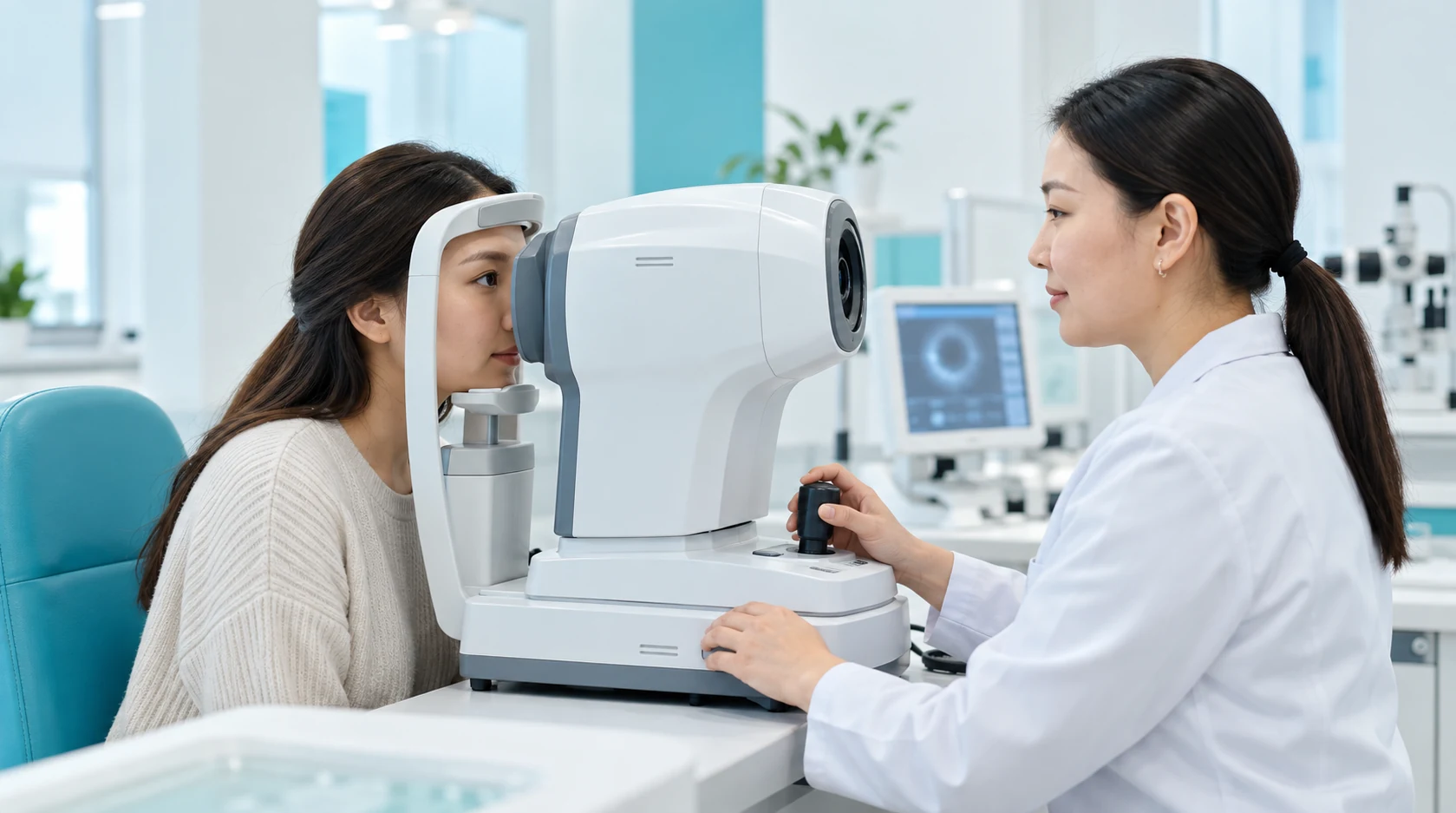
Keratometry, topography or tomography and pachymetry when indicated to exclude irregularity and ectasia.
Cornea, crystalline lens or both; cataract requires biometry and toric IOL calculation.

Glasses, toric contact lenses, corneal laser surgery, a phakic toric IOL or toric IOL in lens surgery.
Individual instructions on lenses, tests and medicines depend on the procedure.

Technique and anaesthesia are method-specific and cannot automatically be transferred between operations.
Assessment of visual acuity, residual cylinder, cornea or toric IOL position, followed by advice.

Astigmatism correction helps reduce distortion caused by different refractive powers across meridians.
Astigmatism is assessed alongside myopia or hyperopia so the plan addresses the full refractive error.
Testing determines astigmatism magnitude and axis to select suitable optical or surgical parameters.
Glasses, contact lenses and surgery are discussed as distinct options according to clinical indications.
Book diagnostics and a consultation at KazRIED to identify the type of astigmatism and compare correction options. The physician will measure cylinder and axis, assess the cornea and lens, and explain whether spectacles/toric lenses are sufficient or whether a surgical option may be considered.
A team of experienced doctors across specialties.

Candidate of Medical Sciences; Highest-category ophthalmologist

Candidate of Medical Sciences; Highest-category ophthalmologist

Candidate of Medical Sciences; Highest-category ophthalmologist

Candidate of Medical Sciences; Highest-category ophthalmologist

Highest-category ophthalmologist

Highest-category ophthalmologist

Highest-category ophthalmologist
Highest-category ophthalmologist

Highest-category ophthalmologist

Highest-category ophthalmologist
Astigmatism occurs when the eye’s optical power differs between meridians. It is most often related to the shape of the cornea and less commonly to the crystalline lens.
As a result, light does not form a single precise focus on the retina, and images may appear blurred, elongated, or distorted at different distances. Correction is selected according to the cause and type of astigmatism.
Astigmatism correction therefore involves selecting the most suitable method after precise measurements.
At KazRIED, the correction plan is determined after a diagnostic assessment. Options may include glasses or toric contact lenses, corneal laser correction, a phakic toric IOL, or a toric IOL during lens surgery.
The choice depends on the type and regularity of astigmatism, associated myopia or hyperopia, and the condition of the cornea and crystalline lens.
Astigmatism often coexists with myopia or hyperopia, so the prescription includes sphere, cylinder, and axis.
What matters to the patient is the quality of vision with the maximum tolerated correction and the consistency of measurements.
Corneal topography is particularly important before laser surgery.
If the map shows irregularity or signs of ectasia, standard refractive laser correction may be unsafe, even if the cylinder value is technically within the usual range.
In cataract surgery, astigmatism can be taken into account when calculating the artificial lens power.
A toric IOL requires precise measurement of corneal astigmatism and correct alignment with the intended axis. The cost and expected outcome are therefore discussed after biometry and lens calculations.
The goal of surgical correction is to reduce dependence on glasses and improve visual quality. However, residual cylinder, glare, dry eyes, or the need for glasses for certain tasks cannot be completely ruled out in advance.
Related information: Pachymetry.
Kazakhstan’s first specialized ophthalmology institute, operating since 1933.
Modern diagnostics and surgery using world-class equipment.
Leading ophthalmologists in Kazakhstan, scientists and experienced surgeons.
More than 30,000 operations and around 270,000 consultations annually.


Kazakhstan’s first specialized ophthalmology institute, operating since 1933.
Modern diagnostics and surgery using world-class equipment.
Leading ophthalmologists in Kazakhstan, scientists and experienced surgeons.
More than 30,000 operations and around 270,000 consultations annually.
Kazakhstan’s first specialized ophthalmology institute, operating since 1933.
Modern diagnostics and surgery using world-class equipment.
Leading ophthalmologists in Kazakhstan, scientists and experienced surgeons.
More than 30,000 operations and around 270,000 consultations annually.


