


Age considerations
The specific age limits, refractive range and minimum anatomical requirements are determined by the instructions for the ICL model actually used and the surgeon’s decision.
Phakic ICL implantation corrects refractive error while preserving the natural lens. The lens is selected according to optical and anatomical measurements and placed behind the iris.
The specific age limits, refractive range and minimum anatomical requirements are determined by the instructions for the ICL model actually used and the surgeon’s decision.
Adults with stable myopia for whom a refractive surgeon considers ICL more appropriate than corneal laser correction.
Patients with myopic astigmatism who meet the anatomical and optical requirements for a toric ICL.
Patients with sufficient anterior chamber depth and a safe endothelial cell density for the selected model.
Patients with a clear natural lens and useful accommodation when there is no clinical advantage to removing the crystalline lens.
A refractive surgery consultation is reasonable when spectacles or contact lenses are burdensome and corneal laser surgery is limited by refractive magnitude, corneal parameters or other ocular factors.
ICL is not automatically the best option: it should be compared with continued optical correction, corneal laser procedures and, for selected older patients , refractive lens exchange.
High or moderately high myopia when laser correction is outside the safe range for the individual cornea.
Myopia with astigmatism that may be suitable for a toric ICL.
A thin cornea is not itself an indication, but it may reduce the suitability of corneal tissue-removing procedures.
Stable refraction and a desire to reduce dependence on spectacles or contact lenses after risk assessment.
Unstable refraction increases the risk of residual refractive error and an unsatisfactory result.
Cataract or other natural-lens opacity may make a phakic lens inappropriate.
Insufficient anterior-chamber depth, unsafe endothelial cell density or a closed or excessively narrow angle may exclude some phakic IOL models.
Uncontrolled glaucoma, active uveitis, infection, significant corneal disease and some retinal conditions require a separate plan.
Unstable refraction increases residual-error and unsatisfactory-outcome risk.
ICL does not treat amblyopia, retinal or optic nerve disease, or provide acuity beyond the eye's anatomical potential.
Even accurate correction may leave halos, glare, residual error, a need for glasses in some situations and later age-related presbyopia.
Comprehensive diagnostics confirm ICL suitability in terms of refraction, anterior-chamber depth, endothelium, crystalline lens, retina and other measurements.
The doctor calculates the phakic lens power and size; for Toric lenses, the cylinder and implant axis are also calculated.
Patients willing to attend short-term and long-term follow-up.
Cataract or other natural-lens opacity may make a phakic lens inappropriate.
Book a consultation
Comprehensive diagnostics confirm ICL suitability in terms of refraction, anterior-chamber depth, endothelium, crystalline lens, retina and other measurements.
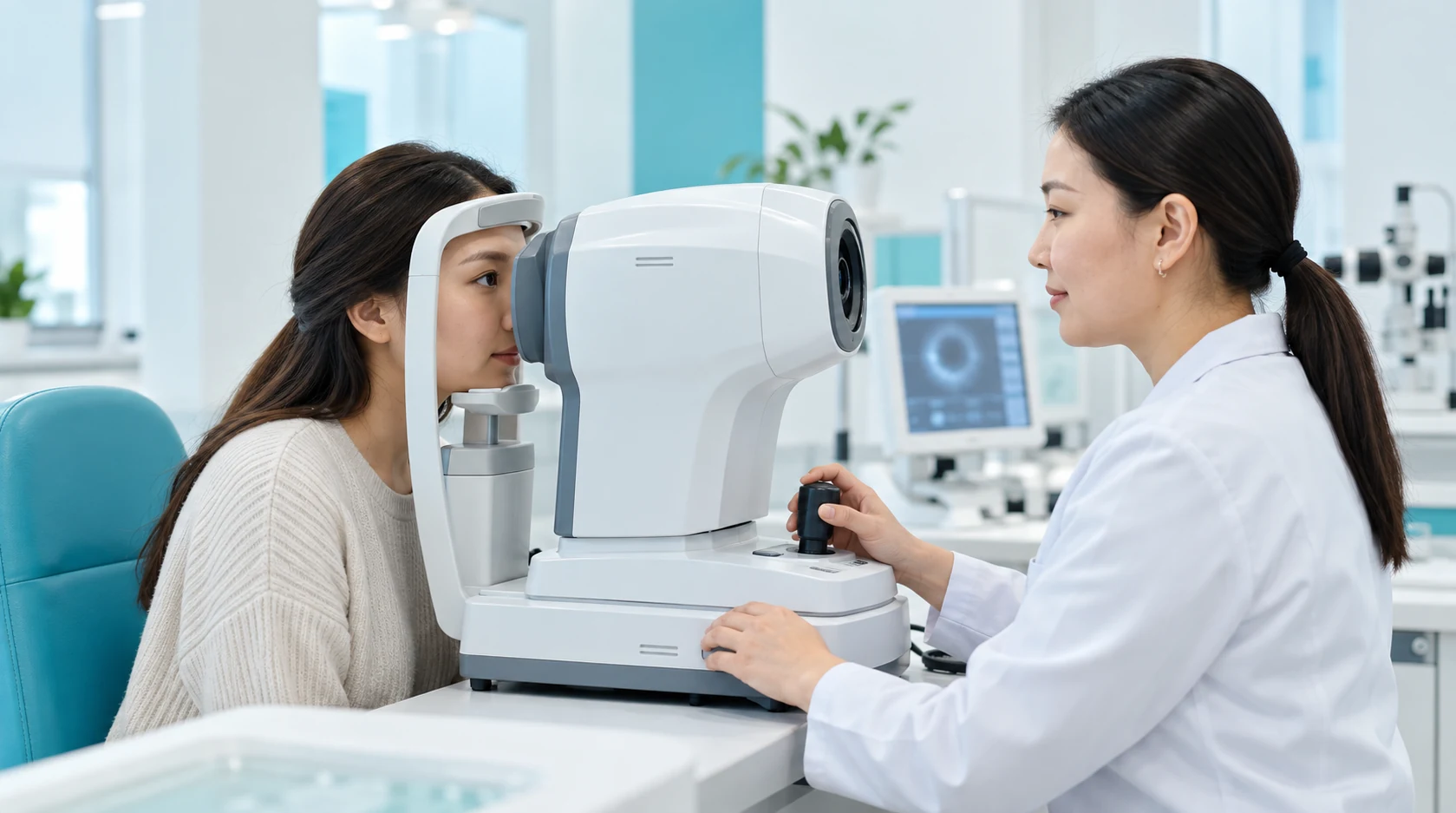
Phakic lens power and size are calculated, with cylinder and axis also planned for Toric lenses.

Through a small corneal incision, the lens is placed behind the iris and in front of the natural lens.

After implantation, the doctor assesses lens position, intraocular pressure and the anterior segment and prescribes drops and a follow-up schedule.

A phakic lens supplements the eye’s optical system without removing the clear natural lens.
Correction is achieved with an additional intraocular lens rather than laser reshaping of the cornea.
ICL may be considered for high myopia within the indications and range of the specific lens.
ICL selection considers both spherical refraction and clinically significant astigmatism.
Visian ICL is a phakic lens placed behind the iris and in front of the natural lens.
Learn moreVisian ICL Toric is a phakic toric lens that corrects refractive error and astigmatism while preserving the natural lens.
Learn moreFind out whether ICL implantation is suitable for you Start with a refractive consultation and a comprehensive assessment. The doctor will assess eye parameters, compare correction options and explain the expected result, limitations and risks.
A team of experienced doctors across specialties.

Doctor of Medical Sciences, Associate Professor; Highest-category ophthalmologist

Candidate of Medical Sciences; Highest-category ophthalmologist
Master’s Student in Public Health

Highest-category ophthalmologist

Highest-category ophthalmologist

Highest-category ophthalmologist

Highest-category ophthalmologist

Highest-category ophthalmologist
Highest-category ophthalmologist
Highest-category ophthalmologist
The doctor calculates the phakic lens power and size; for Toric lenses, the cylinder and implant axis are also calculated.
A phakic intraocular lens (IOL) is an additional optical element implanted inside the eye while preserving the natural crystalline lens. A posterior chamber ICL sits behind the iris and in front of the natural lens.
It changes refraction without laser removal of corneal tissue and preserves natural accommodation if this was intact before surgery.
The method is most often considered for moderate to high myopia, myopic astigmatism, or when corneal laser correction is unsuitable because of anatomical factors.
KazRIED’s current price list separately includes posterior chamber Visian ICL and Visian ICL Toric. Final eligibility is determined after an extended diagnostic assessment and lens calculation.
Anterior chamber and iris-fixated phakic IOLs are separate designs and differ from a posterior chamber ICL.
Diagnostic findings are used to calculate the ICL’s optical power and size. For a toric model, the cylindrical power and implantation axis are also determined.
An important postoperative parameter is vault: the distance between the back surface of the ICL and the anterior capsule of the natural lens. An excessively low or high vault may increase complication risks. Correct sizing and follow-up are therefore important alongside optical power calculation.
Instructions about medications, contact lenses, and required examinations are provided individually.
An ICL can be removed or replaced when medically necessary. However, this does not mean that intraocular surgery is free of risks or lasting consequences.
Possible complications include inflammation, infection, changes in intraocular pressure, endothelial cell loss, cataract, and the need for another procedure.
Postoperative assessments monitor refraction, lens position, vault, intraocular pressure, the natural lens, and the corneal endothelium.
A phakic lens does not stop age-related changes or treat retinal or optic nerve diseases.
Long-term examinations remain necessary even with good vision. Their frequency is determined by the treating clinician.
The listed surgical fee excludes the cost of the IOL.
Kazakhstan’s first specialized ophthalmology institute, operating since 1933.
Modern diagnostics and surgery using world-class equipment.
Leading ophthalmologists in Kazakhstan, scientists and experienced surgeons.
More than 30,000 operations and around 270,000 consultations annually.


Kazakhstan’s first specialized ophthalmology institute, operating since 1933.
Modern diagnostics and surgery using world-class equipment.
Leading ophthalmologists in Kazakhstan, scientists and experienced surgeons.
More than 30,000 operations and around 270,000 consultations annually.
Kazakhstan’s first specialized ophthalmology institute, operating since 1933.
Modern diagnostics and surgery using world-class equipment.
Leading ophthalmologists in Kazakhstan, scientists and experienced surgeons.
More than 30,000 operations and around 270,000 consultations annually.


