

Refractive stability
Adults with stable refraction who meet the age and refractive indication of the specific Visian ICL model.
Visian ICL is a phakic lens placed behind the iris and in front of the natural lens. It corrects refractive error without removing corneal tissue; suitability is determined by diagnostic assessment.
Adults with stable refraction who meet the age and refractive indication of the specific Visian ICL model.
Patients with a clear natural lens and useful accommodation when there is no clinical advantage to crystalline-lens extraction. The natural lens is clear and retaining accommodation is clinically desirable.
Patients with adequate anterior chamber depth and safe angle anatomy.
Patients with age-appropriate corneal endothelial cell density.
A Visian ICL consultation is reasonable when a patient wants to reduce dependence on glasses or contact lenses and the refractive surgeon considers intraocular correction more appropriate than corneal laser surgery.
Stable refractive error within the labelled range of the specific Visian ICL available.
Corneal anatomy or expected laser-surgery tissue limits make a corneal procedure less suitable.
For clinically meaningful astigmatism, spherical Visian ICL may not address the whole refractive error; Visian ICL Toric or another strategy may be required.
High myopia or a thin cornea alone does not automatically mean ICL is indicated.
The patient understands that ICL implantation is intraocular surgery and requires long-term follow-up .
If clinically significant astigmatism is present, the surgeon should separately assess Visian ICL Toric.
Patients for whom the expected benefit of intraocular correction outweighs its risks and who are willing to attend regular follow-up examinations.
Elective refractive surgery is usually deferred during pregnancy and breastfeeding until refraction stabilises.
Cataract or clinically significant crystalline-lens opacity.
Insufficient anterior chamber depth, narrow angle or anatomy outside the requirements of the selected model.
Inadequate corneal endothelial cell density.
Uncontrolled glaucoma or ocular hypertension, active uveitis, intraocular infection and selected corneal disorders.
Unstable refraction that would quickly make the calculated lens power outdated.
Retinal or optic-nerve disease may limit visual potential despite accurate refractive correction.
Recognised risks include IOP elevation, inflammation, infection, endothelial cell loss, unsuitable vault, cataract, glare/halos, residual refractive error, lens displacement and possible exchange or explantation.
Comprehensive refractive and anatomical testing assesses the cornea, anterior chamber, endothelium, crystalline lens, IOP and retina.
If significant astigmatism is present, the need for a toric lens is assessed separately.
Sudden visual loss, increasing pain, marked redness, photophobia, nausea with eye pain or rapid deterioration after surgery requires urgent ophthalmic assessment.
Sudden visual loss, increasing pain, marked redness, photophobia, nausea with eye pain or rapid deterioration after surgery requires urgent ophthalmic assessment.
Book a consultation
Comprehensive refractive and anatomical testing assesses the cornea, anterior chamber, endothelium, crystalline lens, IOP and retina.
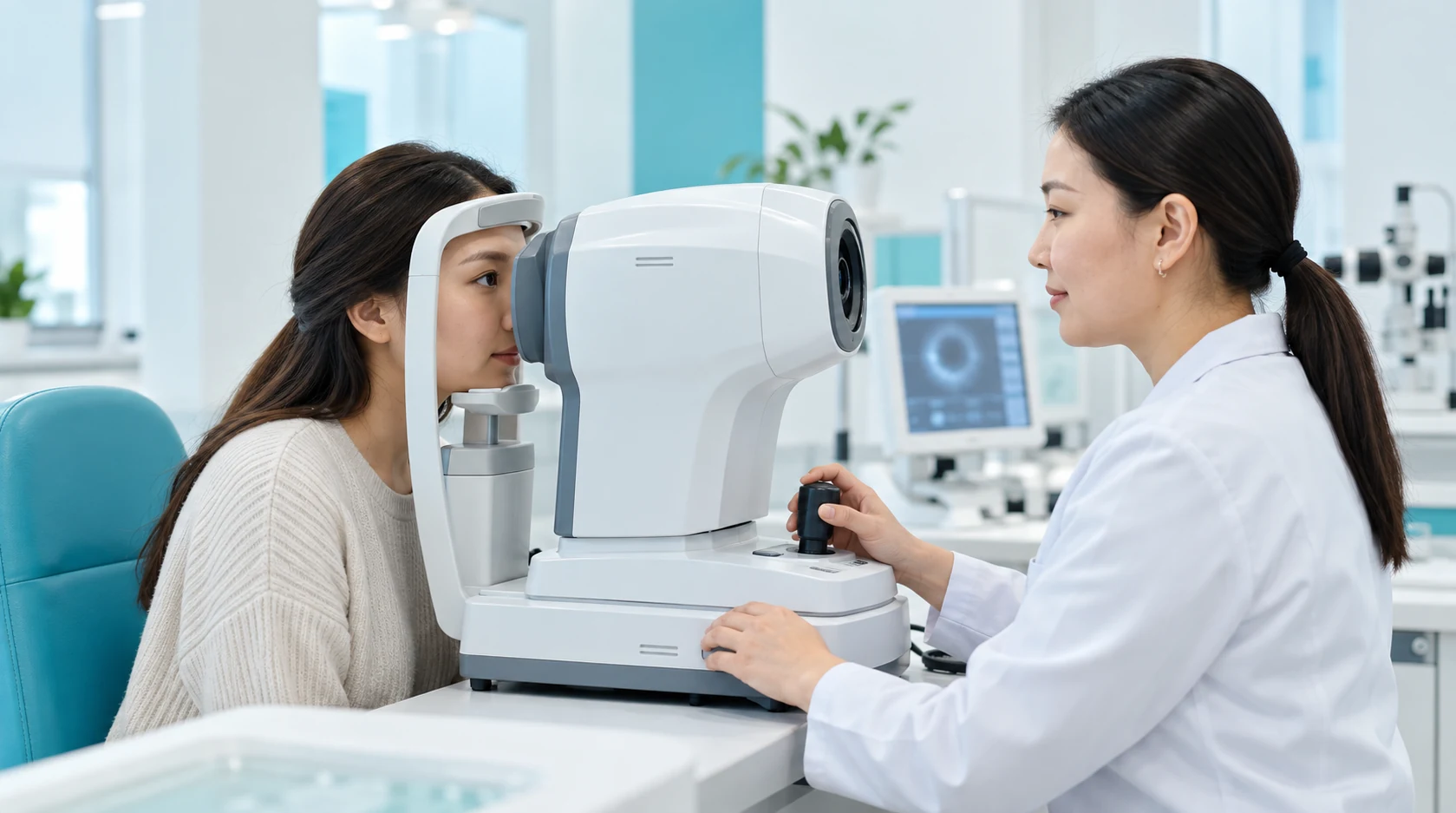
The doctor calculates ICL power and size and considers a toric lens for astigmatism.

The surgeon selects the lens model and individual preparation plan from the findings.

The folded ICL is inserted through a small corneal incision and positioned behind the iris in front of the natural lens.

After implantation, the team checks ICL position, IOP, the anterior segment and vault and provides medication and follow-up instructions.

A phakic lens supplements the eye’s optical system without removing the clear natural lens.
Correction is achieved with an additional intraocular lens rather than laser reshaping of the cornea.
ICL may be considered for high myopia within the indications and range of the specific lens.
Individual measurements help select Visian ICL power and size for the eye’s anatomy.
Book a KazRIED consultation so the ophthalmologist can measure your ocular anatomy, compare Visian ICL with other refractive options and determine whether the specific available lens model is appropriate for you.
A team of experienced doctors across specialties.

Highest-category ophthalmologist

Second-category ophthalmologist

Visian ICL is a posterior chamber phakic intraocular lens. “Phakic” means that the natural crystalline lens is preserved. The implant sits behind the iris and in front of the anterior lens capsule, providing additional optical power inside the eye.
The Visian ICL family is manufactured by STAAR Surgical from Collamer material. According to the manufacturer, correction ranges and the availability of options for myopia, hyperopia, and astigmatism vary by region.
Visian ICL selection combines optical calculation with an assessment of anatomical safety. The clinician considers:
Lens power and size are calculated using diagnostic and biometric findings.
Vault is the distance between the back surface of the ICL and the anterior capsule of the natural lens.
An excessively low vault may increase the risk of lens contact and anterior capsule opacification. An excessively high vault may adversely affect the anterior chamber angle and intraocular pressure.
Correct sizing and postoperative monitoring are therefore important alongside optical power selection.
High myopia requires a careful peripheral retinal examination. Identified changes may affect the sequence of treatment.
The exact model, lens generation, diopter range, and anatomical criteria must be confirmed for the lens actually used at KazRIED.
FDA labeling for the classic Visian ICL includes model-specific limits for age, anterior chamber depth, and minimum endothelial cell density. These criteria should not automatically be applied at KazRIED without confirming the specific model.
The listed surgical fee excludes the cost of the IOL.
Kazakhstan’s first specialized ophthalmology institute, operating since 1933.
Modern diagnostics and surgery using world-class equipment.
Leading ophthalmologists in Kazakhstan, scientists and experienced surgeons.
More than 30,000 operations and around 270,000 consultations annually.


Kazakhstan’s first specialized ophthalmology institute, operating since 1933.
Modern diagnostics and surgery using world-class equipment.
Leading ophthalmologists in Kazakhstan, scientists and experienced surgeons.
More than 30,000 operations and around 270,000 consultations annually.
Kazakhstan’s first specialized ophthalmology institute, operating since 1933.
Modern diagnostics and surgery using world-class equipment.
Leading ophthalmologists in Kazakhstan, scientists and experienced surgeons.
More than 30,000 operations and around 270,000 consultations annually.


